


Africa GDP Ranking 2026 by Country: Figures and Analysis
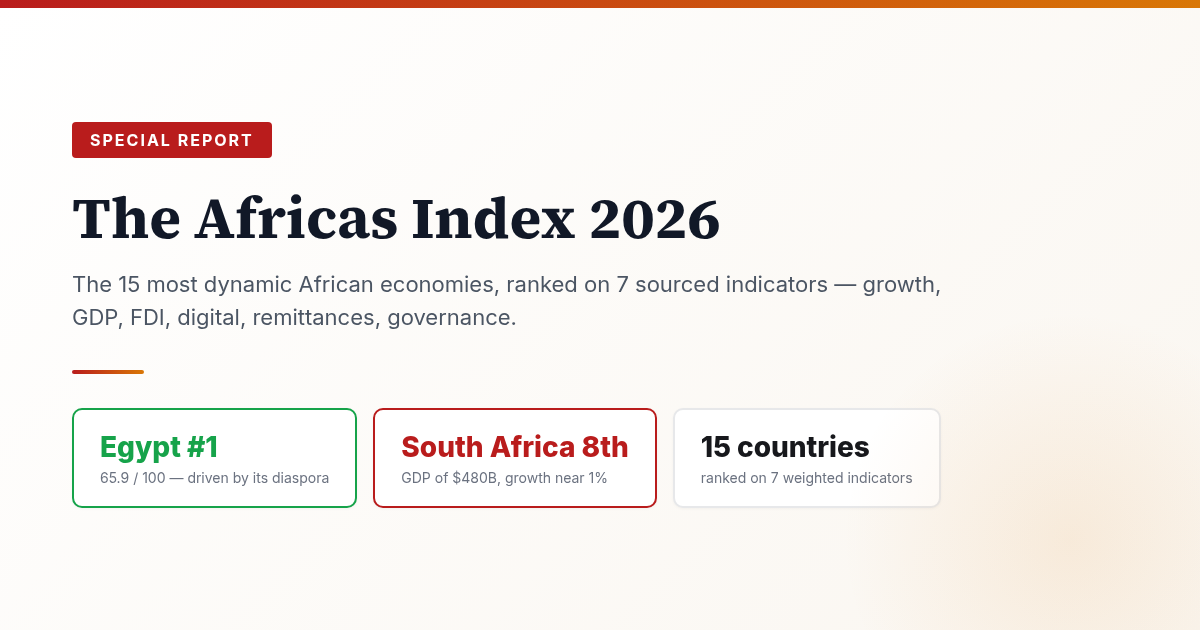
What is Africa’s largest economy in 2026? South Africa dominates the Africa GDP ranking 2026, ahead of a transforming Egypt and a Nigeria reconfiguring its model. But the real story is happening elsewhere: Côte d’Ivoire, Ethiopia, Senegal and DRC are shaking up the top 10. Here is the complete country ranking, the key figures and what they truly reveal about the continent’s economic dynamics.
The ranking below uses nominal GDP, expressed in dollars. It is the most readable indicator for comparing the size of economies, but it is sensitive to exchange rates.
Africa GDP Ranking 2026 by Country
| Rank | Country | Nominal GDP 2026 | Quick read |
|---|---|---|---|
| 1 | South Africa | 480.0 B $ | diversified economy, finance and industry |
| 2 | Egypt | 429.6 B $ | demographic weight, industry and major projects |
| 3 | Nigeria | 377.4 B $ | massive domestic market, oil and services |
| 4 | Algeria | 317.2 B $ | hydrocarbons and domestic demand |
| 5 | Morocco | 194.3 B $ | export industry, tourism, finance |
| 6 | Angola | 152.4 B $ | oil and economic reconstruction |
| 7 | Kenya | 147.3 B $ | services, technology and regional logistics |
| 8 | DRC | 123.4 B $ | mining, population and domestic potential |
| 9 | Ethiopia | 121.5 B $ | rapid growth, industry and agriculture |
| 10 | Ghana | 118.3 B $ | gold, cocoa, services |
| 11 | Côte d’Ivoire | 112.1 B $ | agro-industry, port and consumption |
| 12 | Tanzania | 94.9 B $ | mining, tourism, urban growth |
| 13 | Uganda | 73.4 B $ | agriculture, energy, services |
| 14 | Cameroon | 65.1 B $ | Central Africa hub |
| 15 | Tunisia | 60.7 B $ | industry, services and exports |
| 16 | Zimbabwe | 56.7 B $ | mining and agriculture |
| 17 | Libya | 52.5 B $ | oil, but high volatility |
| 18 | Sudan | 44.7 B $ | economy weakened by conflict |
| 19 | Zambia | 41.2 B $ | copper and energy |
| 20 | Senegal | 40.5 B $ | services, energy, logistics |
What GDP Really Says
A high GDP indicates a deep market: more businesses, greater consumption, denser supply chains and often a more developed banking sector. But this does not automatically mean that households are wealthier or that processes are simpler.
This is why this ranking must be read alongside GDP per capita, the human development level and concrete on-the-ground signals: stability, access to energy, ports, roads, taxation, payment delays.
Countries to Watch
Côte d’Ivoire, Kenya, DRC, Ethiopia, Senegal and Benin deserve particular attention. Their weight is not always comparable to that of the top three, but their growth, urbanization or regional role open up faster markets to penetrate.
- Synthetic overview: top 30 richest countries in Africa 2026.
- Entrepreneurial angle: profitable business in Africa, ideas by country.
- Development perspective: GDP or HDI, what should you look at?.
Sources and Methodology
The figures should be read as orders of magnitude, as projections change with exchange rates, inflation and statistical revisions. Sources used: IMF, World Economic Outlook, World Bank, UNDP.
Limitations to Keep in Mind
Nominal GDP favors countries whose currency holds up better against the dollar. An economy may produce more in volume, but appear weaker in dollars if its currency depreciates. This is one of the reasons why African rankings sometimes change sharply from one year to the next.
It is also important to distinguish between the formal economy and the lived economy. In several countries, a significant share of activity takes place in the informal sector: street trade, family services, agriculture, transport, small workshops. This activity exists, supports households, but does not always appear precisely in statistics.
Useful Reading for Businesses
For selling, recruiting or investing, GDP serves as an entry point. Then you need to look at the city rather than the country: Lagos is not Abuja, Douala is not Yaoundé, Abidjan is not the Ivorian interior. National size provides a framework; the decision is often made neighborhood by neighborhood, sector by sector.
GDP Profiles by Country 2026
Find our detailed country-by-country analyses, with official figures, key sectors and regional comparison:
Why the Africa GDP Ranking 2026 Has Changed Compared to Previous Years
The Africa GDP ranking 2026 is not a simple update of previous figures. Several major shifts explain the changes observed this year.
Nigeria drops to third place. Long considered Africa’s leading economy in nominal GDP, Nigeria is suffering from a structurally weakened naira since the exchange rate reform of 2023. In current dollars, its GDP is mechanically compressed even as the real economy continues to grow. This is a conversion effect that illustrates the fragility of dollar-based comparisons for economies with high monetary volatility.
South Africa reclaims the top spot. The rand has held up better than the naira, and the finance, mining and services sectors have benefited from a renewed confidence linked to the formation of the national unity government. South Africa’s GDP in current dollars is thereby strengthened, even if real growth remains modest at around 1.5% to 2%.
Egypt consolidates its second place despite turbulence. The Egyptian pound has undergone several successive devaluations since 2022, but major infrastructure projects, the Suez Canal and the development of liquefied natural gas support the nominal GDP mass. The IMF has maintained its support for the reform program, stabilizing expectations.
African emerging economies accelerate. Côte d’Ivoire symbolically crosses the 112 billion dollar mark, driven by agro-industry and an expanding services sector. Tanzania and Uganda are progressing steadily thanks to real growth rates above 5%. Senegal, now an oil and gas producer since early 2024, is embarking on a new trajectory that should move it up the ranking by 2027-2028.
Special cases. Libya remains underestimated in this ranking: its real oil revenues depend on agreements between factions and exported volumes, which fluctuate sharply. Sudan, at war since April 2023, is seeing its economy collapse, and its ranking reflects more of a pre-conflict situation than the reality of 2026.
Africa GDP Ranking 2026: The 5 Most Dynamic Economys to Watch
Beyond the raw ranking, the most strategic indicator for investors, decision-makers and observers is not absolute size but trajectory. Here are the five African economies that combine solid real growth, engaged structural reforms and potential to move up in the Africa GDP ranking by 2028.
1. Côte d’Ivoire — The West African model. With a real growth rate of around 6 to 7% per year, Abidjan is asserting itself as the financial hub of French-speaking West Africa. The autonomous port of Abidjan remains the largest in the sub-region, and the rise of the processed cocoa industry — rather than raw exports — represents a deep structural change. Current GDP: 112 B $. 2028 potential: 135-145 B $.
2. Ethiopia — The demographic powerhouse awakens. Africa’s second most populous country with more than 130 million inhabitants, Ethiopia has maintained one of the continent’s highest real growth rates despite the Tigray conflict. With peace restored and investments in textile industrial zones attracting international groups again, the challenge remains access to foreign currency and birr convertibility. Current GDP: 121 B $. 2028 potential: 145-160 B $.
3. Senegal — The oil-and-gas effect begins. With the first barrels from the Sangomar field and the gas from the GTA project (Grand Tortue Ahmeyim) ramping up, Senegal is entering a new economic era. Hydrocarbon revenues are being added to an already solid services sector (telecommunications, banking, tourism). Current GDP: 40 B $. 2028 potential: 55-65 B $.
4. DRC — The underexploited mining giant. The DRC holds the world’s largest cobalt reserves, as well as major reserves of copper, coltan and gold. With structural demand linked to the global energy transition (batteries, electric vehicles), the country is positioned to capture considerable resource rents. The question remains governance, security in the East and the capacity to process locally. Current GDP: 123 B $. 2028 potential: 150-175 B $.
5. Kenya — East Africa’s technology and logistics hub. Nairobi has become the African Silicon Savannah: M-Pesa revolutionized mobile finance, and the startup ecosystem is attracting steadily growing venture capital. The port of Mombasa and the corridor to Uganda, Rwanda and DRC make Kenya an indispensable logistics node. Current GDP: 147 B $. 2028 potential: 170-185 B $.
African Economys to Watch in 2026: The Rising Outsiders
Beyond the fixed podium, several African economies are showing remarkable growth trajectories in 2026 and deserve particular attention in any serious GDP ranking.
Côte d’Ivoire (11th, 112.1 B $) confirms its status as the UEMOA locomotive. Driven by agro-industry, the development of the port of Abidjan and rising domestic consumption, it should cross the symbolic threshold of 120 billion dollars by 2027 according to IMF projections.
Ethiopia (9th, 121.5 B $) remains the ranking’s surprise. Despite internal tensions, it maintains one of the continent’s highest growth rates thanks to its textile industry, infrastructure and a population of over 125 million that constitutes a leading domestic market.
Senegal (20th, 40.5 B $) is arguably the country most closely watched by investors. The start of production from oil and gas fields (Sangomar, GTA) is likely to propel its GDP by 20 to 30% over the next two years, placing Dakar in the African top 15 before 2028.
DRC (8th, 123.4 B $) holds the continent’s most underexploited mining potential — cobalt, coltan, lithium — strategic raw materials for the global energy transition. Its rise in the ranking will depend directly on political stability and attractiveness to foreign capital.
These dynamics illustrate a frequently overlooked reality: the Africa GDP ranking 2026 is not a static photograph; it is a snapshot of a continent in rapid reorganization.
Africa GDP 2026: How to Read and Compare This Country Ranking
The Africa GDP ranking 2026 by country is based on nominal GDP in current dollars, the most widely used measure for comparing the raw size of economies. But to interpret it correctly, several nuances are necessary.
Nominal GDP vs. GDP at Purchasing Power Parity (PPP)
In purchasing power parity, the ranking changes significantly. Egypt and Nigeria move up sharply, as the cost of living there is notably lower than in South Africa. PPP better reflects the real purchasing power of populations, while nominal GDP remains the standard benchmark for international comparisons and financial markets.
The Exchange Rate Effect
Several African currencies have suffered sharp depreciations against the dollar in 2024-2025 (Nigerian naira, Egyptian pound, Congolese franc). A GDP measured in dollars can therefore fall not because the real economy is contracting, but because the local currency has weakened. This is one of the reasons why Nigeria, despite being Africa’s largest economy in PPP, appears 3rd in nominal terms.
Size ≠ Individual Wealth
A high GDP can mask glaring inequalities. South Africa, top of the ranking, has one of the highest inequality rates (Gini) in the world. Conversely, countries with a modest total GDP may offer a comfortable standard of living thanks to a small population and better redistribution. To go further, consult our Africa GDP per capita ranking 2026.
FAQ — Africa GDP 2026
Which country has the highest GDP in Africa in 2026?
Nigeria remains Africa’s largest economy with a GDP of approximately 617 billion USD in 2026, ahead of Egypt (474 B) and South Africa (403 B). These three countries alone account for nearly 45% of continental GDP.
How is African GDP evolving in 2026?
The continent is posting average growth of 3.8% in 2026 according to the IMF, driven by East Africa (Ethiopia, Kenya, Tanzania) and oil economies (Angola, Algeria). This growth remains above the global average of 3.2%.
What is the difference between nominal GDP and PPP GDP in Africa?
Nominal GDP measures output in current dollars, which penalizes countries with a low cost of living. GDP at purchasing power parity (PPP) corrects for this effect: Ethiopia, for example, moves from 126 B USD nominal to over 370 B USD in PPP, changing its continental ranking.
📌 Complete guide: Africa GDP 2026: ranking and analysis by country
Which country has the highest GDP in Africa in 2026?
In 2026, South Africa is the country with the highest nominal GDP in Africa, at approximately 480 billion dollars. It leads ahead of Egypt (429.6 B $) and Nigeria (377.4 B $), which historically held first place before the depreciation of the naira compressed its GDP expressed in current dollars. This ranking can shift rapidly depending on exchange rates: in GDP at purchasing power parity (PPP), Nigeria remains the continent’s largest economy.
Why is Nigeria no longer first in the Africa GDP ranking in 2026?
Nigeria lost its position as Africa’s largest economy due to the sharp depreciation of the naira since the foreign exchange market reform undertaken in 2023 under President Tinubu. This reform, necessary to unify multiple exchange rates, mechanically reduced the value of Nigeria’s GDP expressed in US dollars, even though the country’s real economy remains the largest in Africa by volume. In GDP at purchasing power parity (PPP), Nigeria retains its dominant position with a PPP GDP estimated at over 1,100 billion international dollars.
Which country has the highest GDP in Africa in 2026?
In 2026, South Africa is the African country with the highest nominal GDP, estimated at approximately 480 billion dollars. It leads ahead of Egypt (429.6 B $) and Nigeria (377.4 B $). This nominal GDP ranking may differ from the purchasing power parity (PPP) ranking, where Nigeria generally comes first due to the size of its population and lower cost of living.
Why is Nigeria not first in the Africa GDP ranking 2026?
Nigeria is often cited as Africa’s leading economy, but this ranking applies mainly in purchasing power parity (PPP). In nominal GDP (in current dollars), the sharp depreciation of the Nigerian naira against the dollar since 2023 has considerably reduced the weight of its economy expressed in foreign currencies. This is why Nigeria appears 3rd in this 2026 ranking, behind South Africa and Egypt.