


Introduction
Algeria is attracting the attention of investors from the French-speaking diaspora: price per square meter still significantly lower than in Paris or Montreal, a market in the process of digitalization and successive reforms to investment law. But the Algerian real estate market operates according to very specific rules, and the first of these is often misunderstood: contrary to what many guides suggest, a foreigner cannot freely purchase an apartment there. Full real estate ownership by non-nationals remains regulated, and access to land actually goes through another channel — that of economic land managed by the Algerian Agency for Investment Promotion (AAPI). Here is an accurate, sourced and honest overview of the market in 2026.
The reality of the legal framework: what a foreigner can (and cannot) buy
The principle must be stated unambiguously: the acquisition of residential real estate by a non-Algerian foreigner is possible in law, but it is subject to prior authorizations and a state right of pre-emption, which makes it rare in practice. Decree n° 83-344 of 21 May 1983, still in force, establishes the freedom of real estate transactions for foreigners, but subjects it to a dual constraint: the obligation for the foreign buyer to obtain authorization from the wali (prefect of the wilaya), and a right of pre-emption recognized for the State, local authorities and public bodies (source: Brahimi law firm, attorney at the Bouira bar). Historically, decrees n° 72-32 and 72-132 of 1972 had even rendered null and void the transfers of buildings belonging to non-resident foreigners, except with authorization from the Ministry of Finance. Agricultural land, meanwhile, is purely and simply prohibited for foreigners.
In plain terms: a non-Algerian national wishing to acquire housing in Algeria must go through prior authorization from the wilaya and is exposed to the State’s right of pre-emption. This is an exceptional regime, not an open market. Content claiming that a French citizen can “freely purchase” an apartment in Algeria oversimplifies the administrative and legal reality.
Law 22-18: the real entry point for the foreign investor
Law n° 22-18 of 24 July 2022 on investment has profoundly modernized foreigners’ access to the Algerian market, but on the economic front, not the residential one. It enshrines the freedom to invest for “any natural or legal person, national or foreign, resident or non-resident,” as well as transparency and equal treatment. Above all, it confirmed the end of the so-called “51/49” rule which, since 2009, had imposed a majority Algerian stake: this constraint now only remains for strategic activities (hydrocarbons, mining, defense-related industries, ports and airports, pharmaceuticals) and the importation of goods intended for resale as-is. Everywhere else, a foreign investor can hold up to 100% of their company without a mandatory local partner (source: AAPI, upgrowth.dz).
Economic land via AAPI: the genuinely practicable channel
It is law n° 23-17 of 15 November 2023 that structured access to economic land falling under the private domain of the State. The mechanism is clear and documented: any natural or legal person, national or foreign, resident or non-resident, carrying an investment project, can obtain land through a “mutual agreement concession convertible into a transfer,” for a renewable period of 33 years. The application is submitted exclusively on the investor’s digital platform managed by AAPI, which constitutes the sole submission channel. The concessionaire pays an annual rental fee from the start of the project’s operation, and may request the conversion of the concession into a full transfer after completion of the project, obtaining the certificate of conformity and confirmed entry into operation. They may also mortgage their real right to obtain bank financing (sources: aapi.dz, loucif.law).
Indicative prices by city (in Algerian dinar)
The prices below come from surveys published in 2025 by Algerian real estate platforms and specialized press. They are indicative and vary greatly by neighborhood. The Algerian dinar (DZD) moves according to two rates: an official rate of around 145 DZD per 1 euro (July 2025) and a parallel rate significantly higher, around 250 to 270 DZD per 1 euro over the same period — a gap that weighs heavily on the real profitability of operations financed in foreign currencies.
| City | Average price per m² (2025) | Indicative 3-room apartment | Reference neighborhoods |
|---|---|---|---|
| Alger | 250 000 – 350 000 DA/m² (up to 400 000+ DA/m² in Hydra, El Biar, Kouba) | 15 – 25 millions DA | Hydra, El Biar, Kouba, Ben Aknoun |
| Oran | 180 000 – 250 000 DA/m² | 10 – 18 millions DA | Akid Lotfi, seafront, Oran Est |
| Constantine | City center: 450 000 – 550 000 DA/m² (equiv. 1 800 – 2 200 €/m²) ; Ali Mendjeli/El Khroub: 200 000 – 310 000 DA/m² | 8 – 14 millions DA (city center: 40 – 55 millions DA for a 3/4-room apartment of 90-110 m²) | Place des Martyrs, Coudiat, Ali Mendjeli, El Khroub |
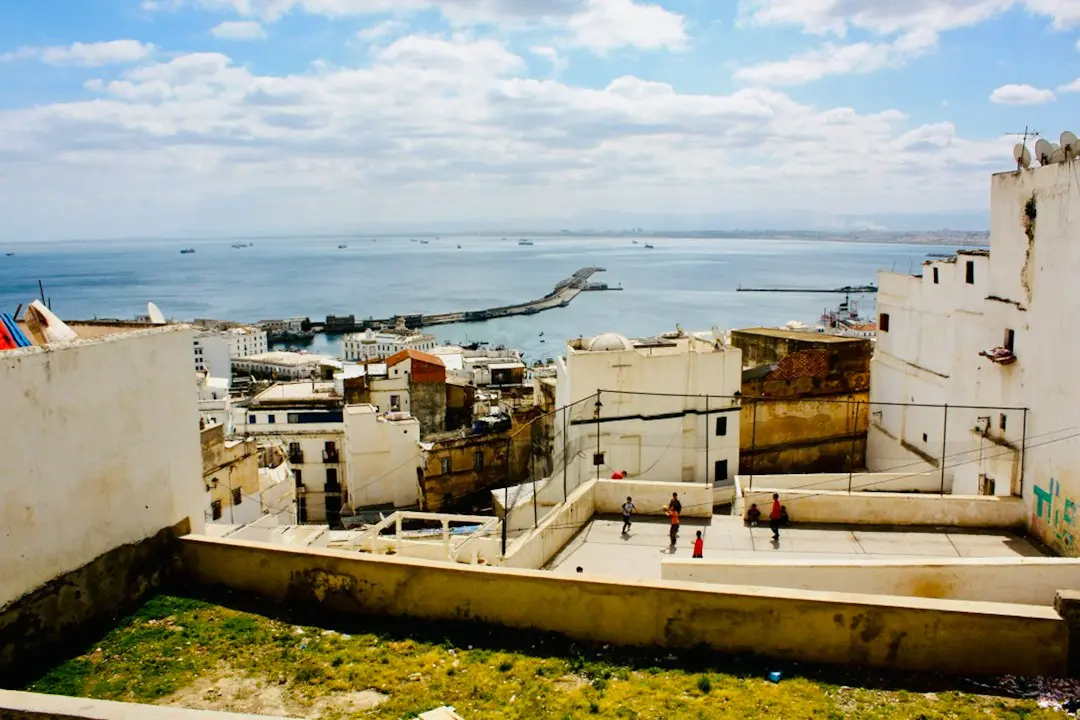
Alger remains the most expensive city in the country. Oran, the second metropolis, shows more moderate but steadily growing prices, driven by its port and tourism development. Constantine is generally less expensive than Alger and Oran for equivalent properties, with the notable exception of its historic city center, perched and with very constrained land supply, where the price per m² occasionally exceeds that of the capital (conversions made at the rate of 260 DZD/€ used by the source). As a social reference point, public promotional housing (LPP) reserved for the diaspora shows capped prices of around 95 000 DZD/m², an order of magnitude far below the open market.
Concrete alternatives for investing from abroad
1. Economic land (industrial and activity zones)
For a non-national, this is the safest and most legally regulated route. It requires, however, a genuine productive investment project (industry, logistics, services), a financing plan and a business plan. The 33-year concession, convertible into a transfer, offers real security: right to a building permit, right of mortgage, possible hereditary transmission. File processing is announced within regulated timeframes (15 days at the AAPI level for certain steps).
2. Real estate development through partnerships
Private real estate development (off-plan purchase, construction monitoring, delivered properties) is the classic entry point for the Algerian diaspora, which benefits from a different status: as nationals, dual nationals can acquire on the open market without the wilaya authorization required of foreigners. Law 22-18 and the end of the 51/49 rule also make it possible to create a real estate development company majority-owned by a foreigner (outside strategic sectors), then acquire land through AAPI to develop a program there. This is the most common arrangement for converting capital in foreign currencies into a productive real estate asset.
3. The open market for the Algerian diaspora
Algerians residing abroad (and dual nationals) can directly purchase old or new properties. Three practical points have changed the situation: the prohibition on cash payments imposed by Article 207 of the 2025 Finance Law (notaries now require full payment by check or bank transfer, on pain of refusing to draw up the deed), the obligation to declare the exact price (no more under-declarations), and the price reference published by the General Tax Directorate for 2025/2026. Funds must transit through the official banking circuit (BNA, BEA, CPA, BADR), which requires accepting the official exchange rate or rigorously justifying the origin of the foreign currencies.
Risks to know before investing
- Exchange rate and rate risk: the gap between the official rate and the parallel rate can reduce the real profitability of an investment financed in euros. The repatriation of funds, meanwhile, is only carried out through the official circuit and, for foreigners, under the conditions of exchange regulations (law 90-10).
- Legal risk for non-nationals: without prior authorization from the wilaya and without an investment project, a residential acquisition by a foreigner may be blocked, or even rendered null and void on the basis of the historical texts of 1972. The State’s right of pre-emption may also be exercised.
- Documentary risk: the absence of a clear and up-to-date land register (title deed) makes the deed fragile. Urban planning compliance and registration with the Land Registry are essential.
- Execution risk: in economic land, the concession is terminable in the event of non-completion of the project within the deadlines of the specifications; conversion into a transfer is only acquired after confirmed entry into operation.
- Regulatory risk: the tightening of financial traceability (anti-money laundering) exposes any operation not conducted through the banking circuit to investigations.
FAQ
Can a non-Algerian foreigner buy an apartment in Algeria?
Not freely. The acquisition of a residential property by a non-national is subject to prior authorization from the wilaya and the State’s right of pre-emption, and agricultural land is prohibited for foreigners. In practice, the genuinely open route is that of economic land via AAPI, within the framework of a productive investment project.
Can Algerians living abroad buy on the same basis as residents?
Yes, as nationals, they can acquire on the open market (old or new) without the wilaya authorization reserved for foreigners. They remain, however, subject to the 2025 rules: mandatory bank payment (cash prohibition), declaration of the exact price and transfer of funds via the official circuit. The AADL 3 social program is not accessible to them, but a quota of 2 000 LPP housing units is reserved for the diaspora.
How to obtain industrial land via AAPI?
By submitting an application on the investor’s digital platform managed by AAPI (sole submission channel), with an investment project, a financing plan and a business plan. The land is granted as a mutual agreement concession of 33 years renewable, convertible into a transfer after completion of the project, certificate of conformity and entry into operation, subject to an annual rental fee.
Also read: Investing in real estate in Africa — complete comparison of 6 markets.
The Les Afriques newsletter
L’essentiel de l’économie africaine — guides, comparatifs et analyses — dans votre boîte mail chaque semaine.