
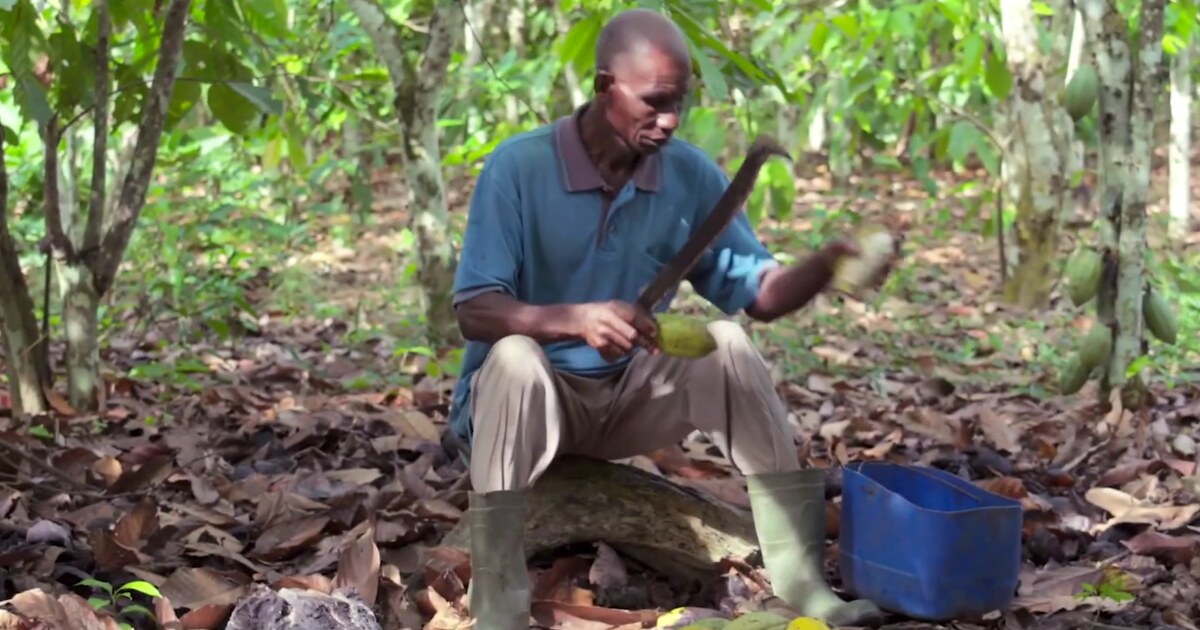
Côte d’Ivoire is still the world’s largest cocoa producer. But the gap at the top has narrowed sharply: output fell from 2.24 million tonnes in the 2022/23 season to 1.67 million tonnes in 2023/24 — the worst campaign in four years for both Abidjan and Accra. The drop has reshuffled the global rankings: Ecuador is now within 30,000 tonnes of Ghana, Nigeria has climbed back above Cameroon, and Brazil has slipped out of the leading pack.
Whether you trade cocoa beans, run a processing operation, or track commodity prices before signing a supply contract, the numbers below cut through any amount of market commentary. The rankings that follow draw on the latest revised estimates from the International Cocoa Organization (ICCO).
The 2026 global cocoa rankings: top ten producers
| Rank | Country | Output 2023/24 (t) | Global share | Change |
|---|---|---|---|---|
| 1 | Côte d’Ivoire | 1,674,000 | 38.3% | −25.3% |
| 2 | Ghana | 449,000 | 10.3% | −31.3% |
| 3 | Ecuador | 419,000 | 9.6% | −7.7% |
| 4 | Nigeria | 350,000 | 8.0% | +11.1% |
| 5 | Cameroon | 320,000 | 7.3% | +18.5% |
| 6 | Brazil | 182,000 | 4.2% | −17.3% |
| 7 | Indonesia | 180,000 | 4.1% | +12.5% |
| 8 | Peru | 157,252 | 3.6% | −5.8% |
| 9 | Colombia | 67,678 | 1.5% | +13.1% |
| 10 | Dominican Republic | 57,461 | 1.3% | −3.9% |
World output 2023/2024: 4.37 million tonnes, down from 5.02 million in 2022/2023 — a fall of nearly 13%. Sources: ICCO for ranks 1 to 7; FAOStat, calendar year 2024, for ranks 8 to 10.
The Afriques newsletter
- Free & no spam
- 1 email per day
- Unsubscribe in 1 click
The top ten account for 3.86 million tonnes, or 88% of world supply. It is a narrow club: the two leaders alone weigh 48.6%.
| Rank | Country | 2023/24 output (tonnes) | Global share | Year-on-year change |
|---|---|---|---|---|
| 1 | Côte d’Ivoire | 1,674,000 | 38.3% | −25.3% |
| 2 | Ghana | 449,000 | 10.3% | −31.3% |
| 3 | Ecuador | 419,000 | 9.6% | −7.7% |
| 4 | Nigeria | 350,000 | 8.0% | +11.1% |
| 5 | Cameroon | 320,000 | 7.3% | +18.5% |
| 6 | Brazil | 182,000 | 4.2% | −17.3% |
| 7 | Indonesia | 180,000 | 4.1% | +12.5% |
| 8 | Peru | 157,252 | 3.6% | −5.8% |
| 9 | Colombia | 67,678 | 1.5% | +13.1% |
| 10 | Dominican Republic | 57,461 | 1.3% | −3.9% |
Global output 2023/24: 4.37 million tonnes, down from 5.02 million tonnes in 2022/23 — a decline of nearly 13%. Sources: ICCO (ranks 1–7); FAOStat, calendar year 2024 (ranks 8–10). Full methodology below.
These ten countries account for 3.86 million tonnes — 88% of global supply. It is a remarkably concentrated sector: the top two producers alone hold 48.6% of worldwide output between them.
Côte d’Ivoire: 38% of global cocoa, but 567,000 tonnes lost in one season
The number-one ranking is intact; the cushion is not. At 1.674 million tonnes, Côte d’Ivoire still produces more than Ghana, Nigeria and Cameroon combined. But it shed 567,000 tonnes in a single crop year — equivalent to wiping out the entire annual output of Cameroon and Indonesia together.
Three compounding causes will be familiar to anyone working the supply chain. Excess rainfall followed by El Niño-driven drought disrupted flowering across the country’s cocoa belt. The swollen shoot virus — a disease that destroys cocoa trees from the roots up — continued to hollow out plantations across the traditional growing zones. And illegal artisanal mining (locally called orpaillage) has eaten into arable land in the west and centre-west. On top of these biological and climatic factors, a significant volume of the harvest is believed to have been smuggled across borders into neighbouring countries, depressing official export statistics without necessarily reflecting the actual number of trees in production.
At farm level, the arithmetic is brutal. Even if the farmgate price — set by Côte d’Ivoire’s Coffee and Cocoa Council — was raised to reflect higher global prices, a grower running five hectares at 500 kg per hectare instead of 700 kg per hectare still takes a hard revenue hit. Volume losses cannot be fully offset by price gains.
Ghana versus Ecuador: 30,000 tonnes separating second place
This is the most consequential shift in the global cocoa rankings in a decade. Ghana has fallen to 449,000 tonnes from 654,000 tonnes in 2022/23 — a 31% collapse, the steepest decline anywhere in the top ten. The drivers are well documented: swollen shoot virus, ageing tree stock, illegal small-scale mining (known as galamsey in Ghana), and cross-border smuggling of beans into Togo and Côte d’Ivoire.
Ecuador, by contrast, lost only 7.7%, landing at 419,000 tonnes. Just 30,000 tonnes now separate the two countries. The South American producer operates on a structurally different model: expanding planted area, some of the highest yields in the world, and a significant proportion of fine-flavour cocoa that commands a premium over bulk commodity grades. Ecuador is the world’s second-largest bean exporter, and it is contesting a ranking it has not been close to for decades.
For European buyers and processors, the shift has immediate practical implications. A grinder that relied on Ghanaian origin beans is now contracting in Ecuador — with a different origin premium, different flavour profiles, and a longer transatlantic logistics chain. Origin diversification, once optional, is becoming structural.
Nigeria and Cameroon: the only West African growers posting gains
Nigeria moved from 315,000 tonnes to 350,000 tonnes (+11.1%), consolidating fourth place. Cameroon grew faster still: 320,000 tonnes against 270,000 the previous season, a gain of 18.5%, representing a clear recovery after two consecutive disappointing harvests. Yaoundé benefited from better seasonal conditions and active quality and traceability support from the National Cocoa and Coffee Board (ONCC — Office National du Cacao et du Café).
One important caveat applies to Nigeria’s figures: a substantial proportion of beans from the country’s south-western cocoa belt exits through informal channels into Benin and Cameroon. Actual production is likely higher than the official statistic, which means the gap between Nigeria and Cameroon is probably narrower and more vulnerable than the table suggests.
Both countries share a structural limitation that matters far more than their ranking: local processing capacity remains capped. The vast majority of their beans are exported raw, leaving the value-added stages — grinding, butter extraction, chocolate manufacturing — to processors in Europe and Asia. That is the defining challenge for the next decade, not where either country sits in this league table.
Brazil, Indonesia and Peru: supply weight is shifting outside Africa
Africa still supplies 71.3% of the world’s cocoa — but that is down from 74.1% the previous season. A three-percentage-point shift in a single crop year is without modern precedent, and it has mechanically increased the relative shares of the Americas (now 22.4% of global output) and Asia-Oceania (6.3%).
Brazil fell 17.3% to 182,000 tonnes, hit by drought in the state of Bahia, its main cocoa-growing region. Indonesia held firm and grew 12.5% to 180,000 tonnes despite ageing plantations and ongoing land competition from palm oil — a more immediately profitable crop on the same soils. Peru held its eighth-place position at 157,252 tonnes, underpinned by fine-flavour beans from the San Martín and Ucayali regions. Colombia (67,678 tonnes, +13.1%) and the Dominican Republic (57,461 tonnes) round out the top ten.
Uganda and the DRC: East Africa’s emerging producers are not there yet
Both countries are frequently cited as the next frontier for cocoa. The numbers tell a more measured story: Uganda produced an estimated 55,000 tonnes and the Democratic Republic of Congo (DRC) around 50,000 tonnes in 2024, according to FAO data — placing both just below the Dominican Republic’s 57,461 tonnes at tenth. Kampala needs roughly 5,000 additional tonnes to break into the rankings.
The underlying momentum is real — new plantings, certified organic production, rising demand from Asian processors — but the scale remains small. For the DRC, the genuine potential of the North Kivu and Tshopo regions runs up against persistent security problems and prohibitive transport costs. The next tier of producers exists; it has not yet changed the global supply picture in any material way.
What this ranking means if you work in the cocoa supply chain
The ICCO estimates a global supply deficit of roughly 440,000 tonnes for the third consecutive season. Benchmark cocoa futures broke $10,000 per tonne in 2024 — a price level not seen in living memory. In theory, scarcity should enrich producers. In practice, the gap between the global exchange price and the income that actually reaches a smallholder farmer remains the sector’s most persistent problem, and it widened when volumes fell.
Two practical consequences follow from the current environment. First, traceability is no longer a marketing add-on — it is a commercial prerequisite. European buyers operating under the EU Deforestation Regulation now require GPS-verified plot-level data for every origin they purchase. Origin countries that cannot supply it will find themselves at a growing commercial disadvantage. Second, local processing is the only lever that changes the value equation for producing nations. The grinder and the chocolate maker capture the margin; the raw-bean exporter absorbs the price volatility without benefiting from the downstream premium.
Methodology and sources
Ranks 1 through 7 are based on ICCO revised estimates for the 2023/24 crop season (October 2023 to September 2024), published in the Quarterly Bulletin of Cocoa Statistics, Volume LI, No. 2, in May 2025. The ICCO does not disaggregate Peru, Colombia and the Dominican Republic in its main summary tables; those three countries are sourced from FAOStat, calendar year 2024, with year-on-year change calculated by comparing 2023 and 2024 FAO figures.
Sierra Leone was excluded from the rankings. FAO data shows its reported output jumping from 12,080 tonnes in 2023 to 93,750 tonnes in 2024 — an eightfold increase that no field-level source corroborates. Publishing that figure would place Sierra Leone ninth globally, ahead of countries whose known production volumes remain well below 30,000 tonnes. The figure has been treated as a likely statistical artefact and set aside.
The sharpest discrepancy between the two data sources involves Indonesia: the ICCO puts its output at 180,000 tonnes, while FAOStat reports 632,702 tonnes for 2024. This article uses the ICCO estimate — which places Indonesia seventh — and flags the divergence explicitly.
All volumes are expressed in marketable cocoa beans, not in butter-equivalent or powder-equivalent weight. Global share percentages are calculated against the ICCO’s total of 4.368 million tonnes for 2023/24. Year-on-year changes compare to the 2022/23 season total of 5.016 million tonnes.
- ICCO — Quarterly Bulletin of Cocoa Statistics, Vol. LI No. 2, production by country
- ICCO — Annual Report 2023/2024, global market overview
- FAOStat — Cocoa bean production by country, calendar year 2024
Further reading
- Cameroon, Côte d’Ivoire, Ghana: who produces the most cocoa?
- Cocoa prices in Cameroon: rates, ONCC and issues
- GDP of Côte d’Ivoire in 2026: figures, cocoa and Abidjan financial hub
Frequently asked questions
Which country produces the most cocoa in the world in 2026?
Côte d’Ivoire, with 1.674 million tonnes in the 2023/24 season. It accounts for 38.3% of global supply — roughly four times the output of Ghana, the next-largest producer.
Is Ecuador about to overtake Ghana as the world’s second-largest cocoa producer?
According to ICCO data, the gap has narrowed to 30,000 tonnes in 2023/24, down from around 200,000 tonnes two seasons earlier. Ecuador is expanding planted area, maintaining comparatively high yields, and growing its share of premium fine-flavour beans, while Ghana has fallen 31% in a single season. A reversal of positions is possible as early as the next crop year — though it is not yet confirmed.
Why did cocoa output fall so sharply in 2023/24?
The global decline of nearly 13% — from 5.02 million to 4.37 million tonnes — reflects a convergence of pressures in the two dominant origins. In Côte d’Ivoire and Ghana, El Niño-related drought followed unusually heavy rains, disrupting flowering; swollen shoot virus continued to destroy tree stock; illegal mining reduced available agricultural land; and cross-border smuggling diverted recorded volumes. Outside West Africa, Brazil was hit by drought in its main growing state.
Who buys African cocoa, and where does the value go?
Most African beans are exported raw to grinders and chocolate manufacturers in the Netherlands, Germany, Belgium and increasingly Asia. Local processing absorbs an estimated one-third of Côte d’Ivoire’s crop and a smaller share in Nigeria and Cameroon. The bulk of value-added production — cocoa butter, powder, chocolate — remains outside the continent.
How much cocoa does Africa produce in total?
3.114 million tonnes in 2023/24, or 71.3% of the 4.368 million tonne world total. Africa’s share stood at 74.1% a year earlier — a loss of almost three percentage points in a single season.
How much cocoa do Uganda and the DRC produce?
55,000 tonnes for Uganda and 50,000 tonnes for the DRC in 2024, according to FAO. Both remain outside the top 10: Kampala needs roughly 5,000 tonnes more to overtake the Dominican Republic, which holds tenth place.