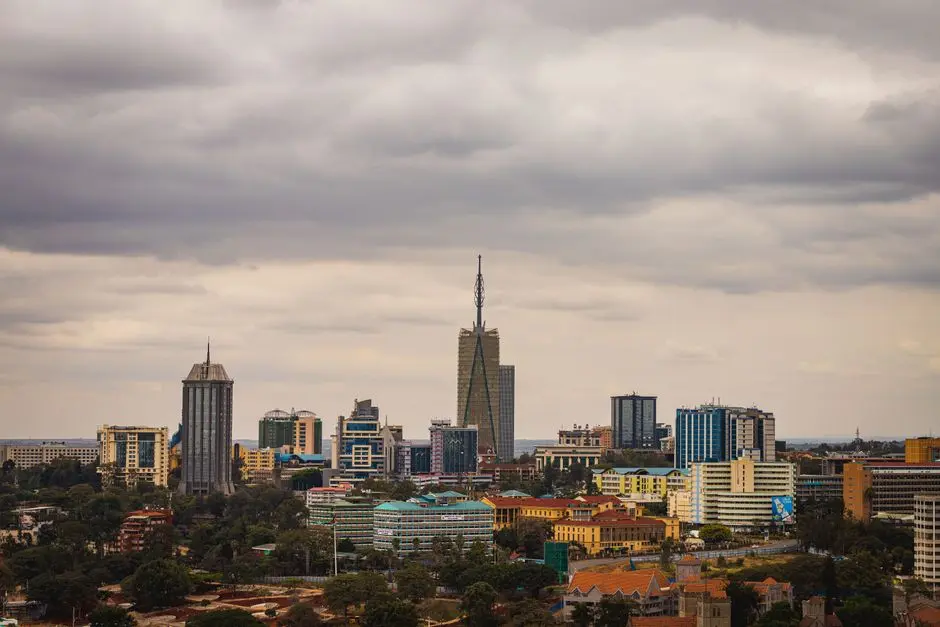




Kenya is the 6th largest economy in Africa in 2026, with a nominal GDP of approximately 130 billion dollars. A technological and financial hub of East Africa, it combines sustained growth, a dynamic startup ecosystem (Silicon Savannah) and a strategic position for regional trade towards Ethiopia, Uganda, Tanzania and Rwanda.
Kenya’s GDP in 2026: key figures and outlook
| Indicator | 2026 Value (estimated) |
|---|---|
| Nominal GDP | ~130 billion USD |
| GDP per capita (nominal) | ~2 350 USD |
| GDP per capita (PPP) | ~6 200 USD |
| Projected annual growth | 5.0 – 5.5 % |
| Inflation | ~5.0 % |
| Continental rank (nominal GDP) | 6th in Africa |
| Currency | Kenyan Shilling (KES) |
Key drivers of the Kenyan economy in 2026
- Financial services and fintech: M-Pesa (Safaricom) remains one of the most advanced mobile payment systems in the world. Nairobi concentrates regional headquarters of banks, investment funds and fintech startups serving all of East Africa.
- Technology (Silicon Savannah): Nairobi is the most active tech hub in sub-Saharan Africa after Lagos. Companies such as Andela, Twiga Foods, Sendy and Copia started there. Google, Microsoft and Meta have regional offices in Nairobi.
- Agriculture and agri-food: tea, coffee, cut flowers (2nd largest exporter in the world after the Netherlands), horticulture and fruits. The sector still accounts for 25 % of GDP and employs 40 % of the active population.
- Tourism: safaris, national parks (Masai Mara, Amboseli) and the Indian Ocean coast. The sector generates more than 2 billion USD in annual revenue. Nairobi’s air connections (Kenya Airways hub) facilitate arrivals from Europe.
- Geothermal energy: Kenya draws 50 % of its electricity from geothermal sources (Rift Valley), giving it a unique competitive energy advantage in East Africa.
Challenges facing the Kenyan economy in 2026
Public debt has risen sharply in recent years, exceeding 70 % of GDP in 2024, which led to significant political and social tensions (June 2024 protests against the finance bill). The Ruto government has implemented austerity measures to reassure international creditors, at the cost of increased pressure on Kenyan households.
Recurrent drought in the northern regions (ASAL — Arid and Semi-Arid Lands) affects pastoral populations and creates recurring humanitarian needs. Dependence on food and energy imports makes Kenya vulnerable to fluctuations in global commodity prices.
FAQ – Kenya’s GDP 2026
What is Kenya’s GDP in 2026?
Kenya’s nominal GDP is estimated at approximately 130 billion dollars in 2026, placing the country 6th in Africa. In purchasing power parity (PPP), the Kenyan economy is valued at approximately 340 billion dollars, reflecting the lower cost of living compared to Europe or North America.
Is Kenya the richest country in East Africa?
Yes, Kenya is the largest economy in East Africa by nominal GDP, ahead of Ethiopia (~175 Bn USD but with a much larger population, therefore a much lower GDP per capita), Tanzania (~90 Bn), Uganda (~50 Bn) and Rwanda (~16 Bn). In terms of wealth per capita and urban infrastructure, Nairobi is the most developed metropolis in the region.
Why does Kenya attract so much foreign investment?
Several factors explain Kenya’s attractiveness: its geographical position as a regional hub (port of Mombasa, Nairobi airport), its educational ecosystem (University of Nairobi, Strathmore), its financial infrastructure (Nairobi Securities Exchange), its relative stability and its technological lead (M-Pesa, Silicon Savannah). These assets make it the natural entry point for companies wishing to establish a presence in East Africa and in landlocked countries (Ethiopia, Rwanda, Uganda, DRC).
The M-Pesa system: how fintech transformed the Kenyan economy
M-Pesa is more than a mobile payment service: it is the financial infrastructure upon which a large part of the Kenyan economy rests. Launched by Safaricom in 2007, it has more than 30 million active users in Kenya and has been replicated in more than 10 African countries. By providing access to financial services for millions of unbanked Kenyans, M-Pesa has enabled the development of a digital economy with no equivalent in sub-Saharan Africa. Economic studies have shown that M-Pesa lifted approximately 2 % of the Kenyan population out of poverty between 2008 and 2016 by enabling female heads of household to access credit and savings. For African startups, the Kenyan model remains the reference upon which innovations in fintech, agritech and logistics are built.
Investing in Kenya: key considerations
Kenya offers an attractive but demanding investment environment. Competition is fierce in the tech and services sectors, where local startups are well established. Corruption remains a real challenge in certain sectors (real estate, public procurement). For foreign investors, partnering with a strong local partner who is well positioned within Nairobi’s political and business networks is often the key to success. Kenya’s legal framework is robust (a legacy of British common law) and offers reliable recourse in the event of commercial disputes.
Kenya’s economic outlook to 2030
Kenya aims to achieve upper-middle-income country status by 2030, in line with the Vision 2030 plan. The technology sectors, logistics (expansion of the port of Mombasa, standard gauge railway towards Kampala), sustainable tourism and renewable energies (geothermal, wind, solar in the north) should support growth of 5 to 6 % per year. The main short-term risk is the sustainability of public debt: repayments on eurobonds and Chinese loans (SGR) absorb a growing share of tax revenues. Agreements with the IMF (ECF programme underway) help to secure public finances but impose painful adjustments for Kenyan households.
See also: ranking of the richest countries in Africa in 2026 and Nigeria, Southern Africa, Égypte: who dominates African GDP?
On the same topic: GDP of Maroc in 2026 and GDP of Côte d’Ivoire in 2026.
See also: Salaries in Kenya — Average salary in Kenya in 2026
See also: Investing in Kenya — Investing in Kenya in 2026: practical guide
📌 Complete guide: Africa GDP 2026: ranking and country-by-country analysis