



In the sandy streets of Nouakchott, a strange excitement reigns. Connected young people, budding start-ups, drones flying over the dunes… Mauritania, long perceived as frozen in its traditions, seems ready to jump on the train of global innovation. But at what cost?
A country at the technological crossroads
Located between the Maghreb and sub-Saharan Africa, Mauritania occupies a strategic position. Yet its technological development has long remained on the margins of major global changes. Until recently.
Since 2020, weak signals have transformed into clear trends: the rise of telecommunications, the growth of e-commerce, and increasing use of renewable energy. The Internet penetration rate has jumped to reach 47% in 2023, compared to barely 10% ten years earlier, according to data from the Regulatory Authority.
“We saw smartphones arrive, then applications, and now artificial intelligence. Everything accelerated in less than five years,” says Mariem, a 28-year-old developer in Nouadhibou. “Before, we didn’t even think it was possible to create a tech company here. Today, it has become possible.”
But this rapid transition also raises concerns: does Mauritania have the means to keep pace with the relentless rhythm of global innovation without losing control of its future?
Start-ups emerge in the desert
In the peripheral neighborhoods of Nouakchott, incubators are springing up. The best known, Hadina RIMTIC, has supported more than 50 young companies since 2018. Among them, SolarNomad, a start-up that installs solar panels in rural areas, and SaharApp, a motorcycle-taxi delivery application adapted to local realities.
“We want to create African solutions to African problems,” explains Ahmed Ould Sidi, founder of SaharApp. “The desert is not an obstacle. It is our terrain of innovation.”
The government, for its part, has begun to timidly support this ecosystem. In 2022, a public fund of 5 million dollars was launched to finance digital projects. A drop in the ocean, but a strong signal.
Yet access to financing remains a major challenge. According to a World Bank study, fewer than 15% of Mauritanian start-ups manage to obtain outside investment. The lack of digital infrastructure and low banking penetration still hinder the sector’s growth.
The green revolution arrives in the Sahel
Energy transition is one of the areas where Mauritania could play a key role. With an average of 3,000 hours of sunshine per year and constant winds along the Atlantic coast, the country has exceptional potential in renewable energy.
In 2023, an agreement was signed with a German company to build a mega solar power plant near Atar. The goal: to produce 100 MW of green electricity by 2026. A project that could transform the local economy and reduce dependence on imported fossil fuels.
But these projects also generate tensions. Local communities are worried about expropriations and environmental impact. “They talk to us about progress, but they never consult us,” laments Cheikh, a livestock farmer in the Adrar region. “What if this energy only benefits the big cities?”
The question of inclusion is crucial. Because innovation that excludes deepens inequalities instead of bridging them.
A connected but vulnerable youth
With more than 60% of the population under 25 years of age, Mauritania holds a trump card: its youth. Curious, creative, eager for change. But also exposed to new risks.
On TikTok, Mauritanian influencers rack up hundreds of thousands of views. From makeup tutorials to awareness videos against racism, young people are using social media to express themselves. But misinformation proliferates there as well.
“Fake news spreads faster than the truth,” warns Aïssata, a journalist in Nouakchott. “And young people, often without critical thinking training, are particularly susceptible to it.”
The education system struggles to keep up. Digital education remains marginal, even as technological skills become essential. In 2022, fewer than 5% of secondary schools offered computer science classes on a regular basis.
The digital divide threatens to become a social divide. And with it, the risk of a disillusioned youth, connected but excluded from opportunities.
When artificial intelligence infiltrates daily life
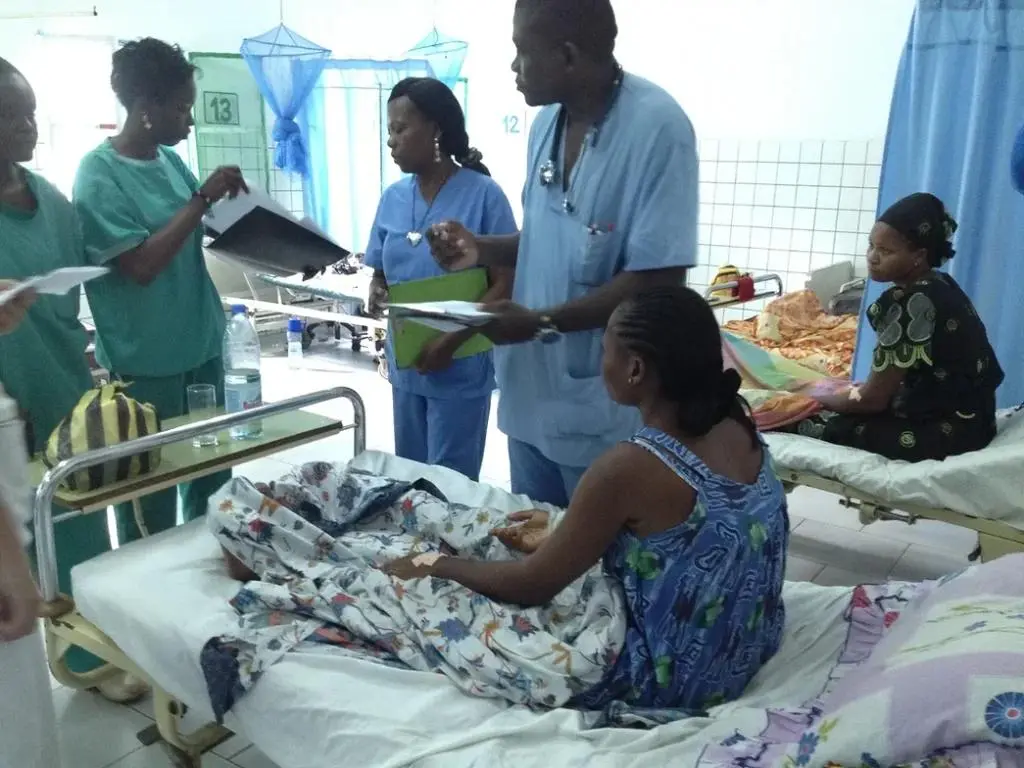
Recently, artificial intelligence has begun to appear in public services. In 2023, the Ministry of Health launched a pilot program using AI to more quickly diagnose certain diseases in Nouakchott hospitals.
“The algorithm helps us detect tuberculosis cases from lung images. This saves us precious time,” explains Doctor Mohamed El Hacen. “But we must remain vigilant: technology must not replace medical judgment.”
In agriculture too, smart sensors are beginning to be used to monitor soil moisture or prevent locust invasions. Promising tools, but still not very accessible to small-scale farmers.
The challenge is significant: how to integrate these cutting-edge technologies into an economic fabric that is still largely informal and poorly structured?
Between digital sovereignty and technological dependence
As Mauritania opens up to global innovations, another question emerges: that of digital sovereignty. Because behind every application, every platform, lies an infrastructure that is often foreign.
Are citizens’ personal data protected? Who controls the algorithms that influence public decisions? In 2022, a report from the African Centre for Cybersecurity warned of the vulnerability of Mauritanian systems to cyberattacks.
“We need a clear strategy to protect our cyberspace,” states Fatimata Ould Mbaye, a lawyer specializing in digital law. “Otherwise, we risk losing our autonomy in a world where information is the new power.”
Local initiatives are emerging to create open source solutions, train cybersecurity experts, or host data on national soil. But they remain marginal in the face of the scale of the challenges.
Mauritania is at a turning point. Between the hope of technological emancipation and the risk of increased dependence, the country advances along a ridge line. Will innovation be a shared opportunity or a mirage reserved for a few?
Also read on African dynamics
To place this subject in a continental perspective, also consult GDP of African countries, profitable businesses in Africa, African capitals and jobs hiring in Africa.