
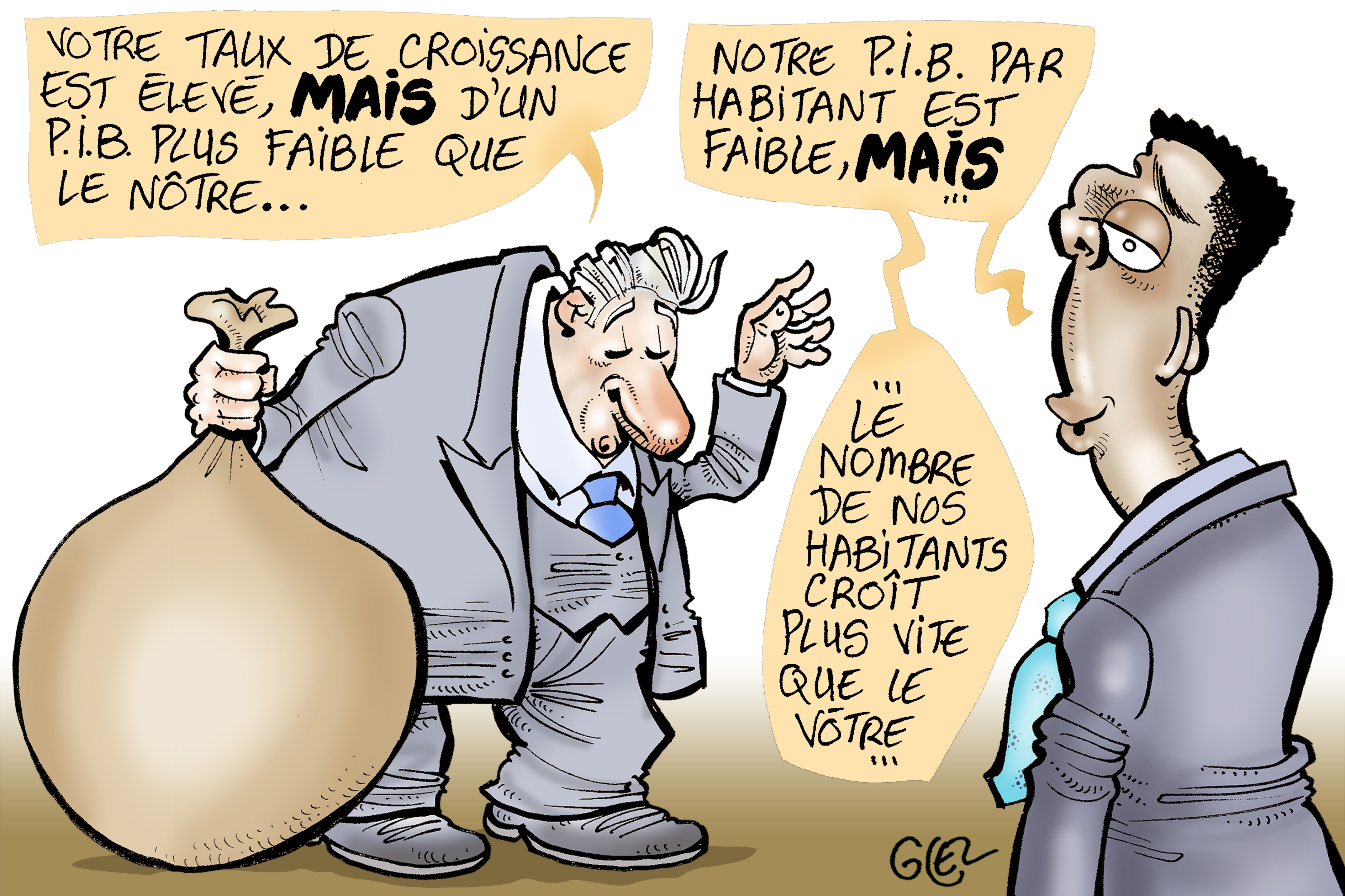
A figure revealed in mid-November by the African Development Bank (ADB) would be enough to make the supposedly major economic powers of America or Europe turn pale. While the United States expects, at best, a growth rate of 2.3% for 2026 and Germany allows itself to hope for no more than 1.3%, the African continent is projected to record, this year according to the ADB, a positive change in its gross domestic product (GDP) of 4.6%.
Viewed less as a snapshot than as a dynamic trend, the updated forecast is all the more encouraging in that it reverses a “slowdown trend” mentioned in a report by the same institution last May, “African Economic Outlook.” Furthermore, the optimism is expected to continue into 2027, with African economic growth anticipated at 4.5%.
A Varied Picture
Admittedly, there are several Africas, and the ADB’s optimism is explained first by the performances of the East and North regions of the continent, then, to a lesser extent, by the results of the southern zone. This is followed by country-by-country analyses that reveal the significant cyclical influence of the energy crisis linked to the conflict in the Middle East. Unsurprisingly, the terms of trade have been favorable, in recent months, to African energy exporters, as well as to importers that took early policy decisions to mitigate the impact of the Iranian conflict on energy supply.
The Afriques newsletter
- Free & no spam
- 1 email per day
- Unsubscribe in 1 click
Moreover, an encouraging growth figure must be put into perspective with an inflation forecast. While the trend is considered rather “disinflationary” in terms of dynamics, inflation could nonetheless stand, respectively for 2026 and 2027, at 9.5% and 8.9%. Levels decidedly higher than those of Germany and the United States, which are supposedly envying the African growth rate…
Cyclical and Structural Factors
While the cyclical impact of the war in the Middle East may fade over the coming months — with the bellicose Donald Trump having to digest his crushing defeat in the midterms — more structural threats will inevitably shake African macroeconomics. One need only mention insufficiently curbed climate degradation, a phenomenon that disrupts agricultural performance and therefore jeopardizes food security. As for global opportunities, Africa is not always best positioned to transform them into growth drivers. Here again, one example suffices: that of technology, which is driving — for better or for worse — even the modest growth rates of Western countries.
It is worth recalling, finally, that an enviable growth rate is only as good as what one does with it. A word to the wise for politicians…

Damien Glez
French-Burkinabe press cartoonist and columnist specialising in African current affairs. His cartoons appear in Jeune Afrique, Le Monde and Courrier international, and he is a member of the Cartooning for Peace network.
View all articles → · glez.org ↗