
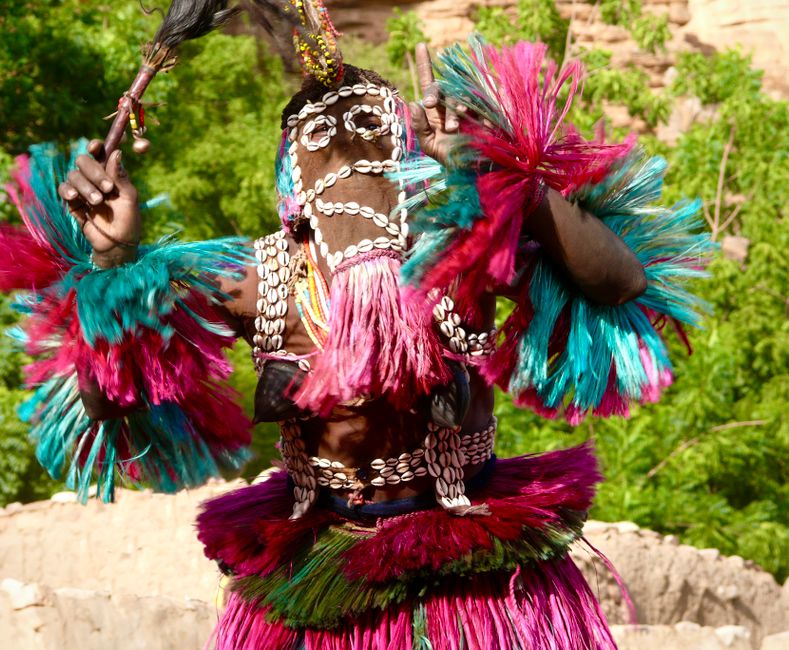
It is not every day that a summit dedicated to women’s leadership singles out a man for its highest honour. On 2 October, at the International Conference Centre of Bamako (CICB), the Mali chapter of the African Women’s Leadership Network (known by its French acronym RLFA — Réseau de Leadership des Femmes d’Afrique) awarded a trophy to Kary Bogoba Coulibaly — better known by his stage name Madou Wolo — one of Mali’s most recognisable figures in comedy, theatre and music.
A one-man orchestra, celebrated by a women’s movement
The ceremony opened the 3rd edition of the International African Women’s Leadership Forum, an event whose stated ambition is to connect and support women driving development across the continent. Nine countries sent delegations — Burkina Faso, Niger, Côte d’Ivoire, Mauritania, Benin, Togo, Ghana and Senegal — while the Republic of Guinea held the place of honour as the edition’s guest country.
Madou Wolo is far from a token guest. Trained at Mali’s National Institute of the Arts, he is fluent across an unusually wide range of instruments — balafon, baara, guitar, kora, piano and drums — earning him the nickname homme-orchestre, roughly translated as “one-man orchestra”. His career stretches back more than 40 years and already carries official recognition: in 2009, then-president Amadou Toumani Touré personally honoured him. The RLFA trophy therefore adds a pan-African women’s-network endorsement to a body of work already validated by Malian institutions.
The Afriques newsletter
- Free & no spam
- 1 email per day
- Unsubscribe in 1 click
Accepting the award, the artist dedicated it to his mother and “to all the women of Mali and of the world”, saying the recognition carried special weight at this stage of a long career. “I am an artist who speaks from the heart, for his country and for his craft,” he said, according to the Malian Press and Advertising Agency (AMAP).
Where culture meets economic development
Choosing to honour a male artist at a women’s leadership event is a deliberate statement. For the organisers, it reflects a vision of culture as a living, transferable force capable of contributing to economic and social development — including, they argue, allowing practitioners, and women artists in particular, to “earn a dignified living from their skills”. The framing attempts to bridge aesthetics and economics, two dimensions that Africa’s creative industries still struggle to link within a stable institutional structure.
This tension is not unique to Mali. Across anglophone Africa — from Nigeria’s Nollywood ecosystem to Kenya’s growing music-export sector and South Africa’s performing-arts infrastructure — the conversation about turning cultural output into sustainable livelihoods is well advanced, yet funding mechanisms and regulatory frameworks remain uneven. The RLFA’s forum signals that francophone West African networks are increasingly engaged in the same debate.
The forum also sets itself the goal of building bridges between women and institutions, suggesting the organisers see it as a platform for structured advocacy rather than simple celebration.
What the award says — and what it leaves open
Recognising Madou Wolo sends a pointed symbolic message: that pan-African women’s networks regard cultural longevity and artistic integrity as values worth elevating in development conversations. That matters, not least because creative-sector workers in the Sahel remain among the most economically precarious on the continent.
Yet the AMAP communiqué leaves several practical questions unanswered. By what criteria was Wolo selected? Does the award come with any material or institutional support, or is it purely honorary? And, critically, what concrete projects in support of Malian or African women artists does the RLFA plan to carry forward beyond the forum itself? The release does not specify the number of participants, commitments made, or any follow-up support mechanisms.
None of this diminishes the symbolism of the moment. But as observers across the continent have noted in comparable contexts — from Accra to Nairobi — the valorisation of African culture, however sincere, gains lasting traction only when ceremonies are paired with durable funding structures, policy linkages and measurable outcomes. Whether this forum produces any of those remains to be seen.
Source: AMAP (Malian Press and Advertising Agency), 2 October 2025