


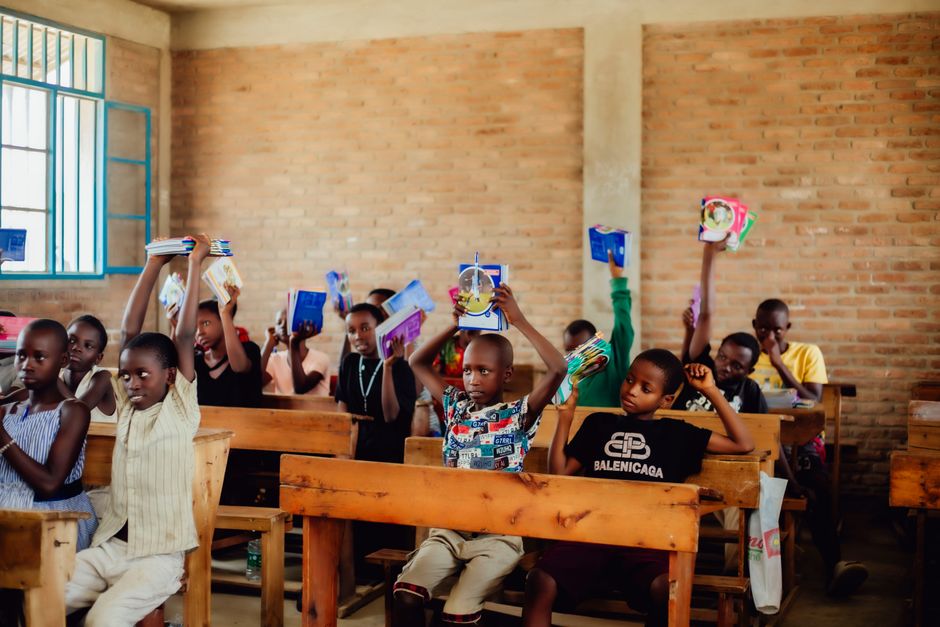
In ten years, the municipality of Louga has multiplied by more than five its annual budget dedicated to school supplies: from 4 million francs CFA in 2014, this budget now reaches 21 million francs CFA for the 2024 school year. It is within this framework that a distribution took place on Saturday in the schools of the northern Senegalese city, reaching both public and private institutions.
A tangible municipal financial effort
Ismaïla Mbengue Fall, deputy mayor in charge of education matters, confirmed that the entire budget of 21 million francs CFA is devoted to covering the supply needs of the commune’s schools. Beyond standard consumables, the municipal council also acquired four photocopiers intended to facilitate the printing of exam papers during tests and assessments — equipment that is often deficient in Senegalese public schools, and whose absence sometimes forces teachers and parents to cover these costs themselves.

The Afriques newsletter
- Free & no spam
- 1 email per week
- Unsubscribe in 1 click
The budgetary progression is real and documented: the increase from 4 to 21 million francs CFA over the decade represents a continuous trajectory, even though the press release does not specify whether this ramp-up was linear or concentrated in recent years.
An initiative to put into context
In the Senegalese context, the involvement of local authorities in financing basic education remains uneven from one municipality to another. The transfer of educational responsibilities to local authorities, enshrined in the decentralization framework, has often run up against insufficient resources or divergent political priorities. Louga’s initiative therefore sits within a landscape where this type of municipal commitment deserves to be noted, without necessarily constituting a generalized norm.
However, a measured perspective on the announcement is warranted. The amount of 21 million francs CFA, spread across the number of institutions — public and private — concerned in a city the size of Louga, may represent modest individual allocations. The press release specifies neither the number of beneficiary schools, nor the distribution criteria between the public and private sectors, nor the types of supplies distributed. These elements are nonetheless decisive in evaluating the real impact of the operation on students’ learning conditions.
What remains to be monitored
The inclusion of private schools in the distribution raises a matter of principle: on what basis do private institutions — some of which may be fee-paying and have their own resources — access municipal public funds? Transparency on the allocation criteria conditions the legitimacy of this type of approach in the eyes of parents and teachers in the public sector.
Furthermore, the purchase of four photocopiers represents a one-off investment whose durability will depend on whether maintenance and consumables are covered in the years ahead — a point that African local authorities frequently underestimate when providing equipment grants.
Finally, the budgetary progression observed in Louga raises a useful question at the national level: to what extent do other Senegalese municipalities allocate comparable resources to education, and is there a monitoring or incentive mechanism to generalize these good practices?
Source: APS (Agence de Presse Sénégalaise), 4 October 2024.