


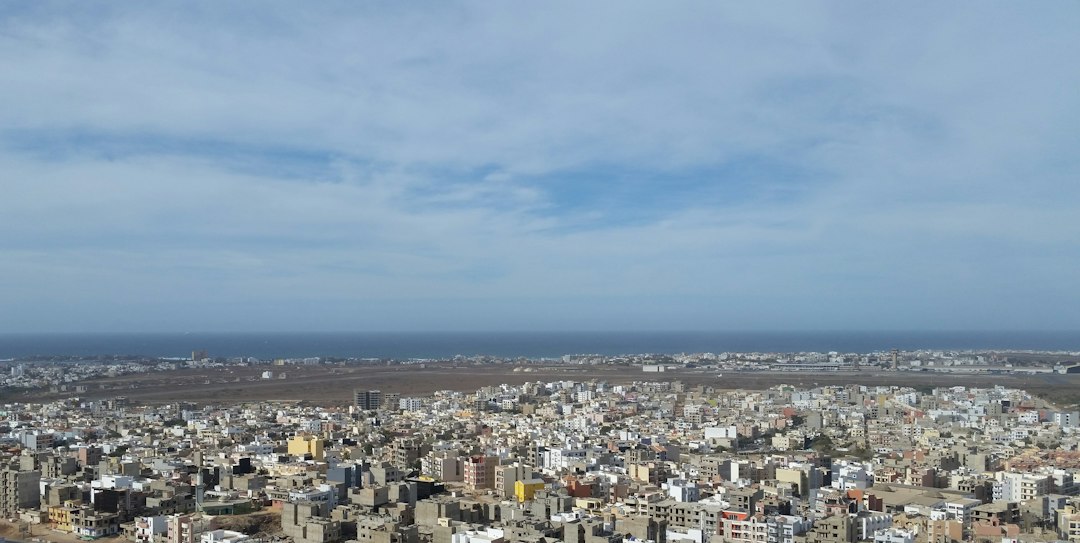
Why Senegal Attracts Foreign Investors
Senegal has established itself as one of the most attractive destinations in West Africa for real estate investment. Driven by a real estate boom in Dakar, sustained demand from the diaspora, and a currency — the CFA franc (XOF) — pegged to the euro at the fixed rate of 655.957 XOF to 1 €, the Senegalese market appeals to non-residents seeking yield and diversification. Diaspora remittances represent approximately 2,200 billion FCFA per year, or nearly 10% of GDP, and a growing share of this savings is being redirected into property: the diaspora accounts for approximately 35% of real estate purchases in Dakar, and up to 65% of acquisitions in the high-end segment.
Sustained economic growth supports this dynamic: Senegal’s GDP grew at an average of 5.3% per year over 2014-2023, and projections pointed to growth of approximately 10.2% in 2025, boosted by hydrocarbons and major infrastructure projects. Over ten years, real estate prices in Dakar have increased by approximately 90% in nominal value (55% after inflation). For an investor thinking in euros, the peg of the CFA franc to the euro eliminates exchange rate risk.
Price per m² by Area in 2026
The Dakar market is highly heterogeneous: price differences between the high-end waterfront and the outskirts can exceed a factor of five. The figures below, in CFA francs (XOF), come from actual listings and 2025-2026 market guides cross-referenced from multiple sources.
Central Dakar (general average). The average price per m² for an apartment in Dakar is around 878,000 FCFA/m² (median: 800,000 FCFA/m²), for an average apartment price of approximately 151 million FCFA.
Les Almadies. The most sought-after neighborhood, on the western tip of Dakar, Les Almadies is home to embassies, expatriates, and luxury hotels. A quality apartment there is negotiated between 900,000 and 1,500,000 FCFA/m², with high-end new developments marketed between 2,000,000 and 3,500,000 FCFA/m², with exceptional waterfront properties reaching up to 5,500,000 FCFA/m². A quality 3-room apartment starts at around 140 million FCFA.
Ngor and Virage. A seaside area appreciated for its mix of local residents and expatriates, Ngor shows average apartment prices of around 750,000 FCFA/m² for existing stock, but new waterfront developments rise to 2,000,000-3,500,000 FCFA/m².
Plateau and Mermoz / Point E / Fann. The Plateau, the administrative and business hub, ranges between 1,500,000 and 2,200,000 FCFA/m². Mermoz, Point E, and Fann range between 1,500,000 and 2,500,000 FCFA/m² (Mermoz averaging around 950,000 FCFA/m² for existing stock).
Saly and Mbour (Petite Côte). About an hour from Dakar, Saly is the benchmark seaside resort. Average prices across all property types are around 930,000 FCFA/m²: approximately 925,000 FCFA/m² for an apartment and from 936,000 to 1,139,000 FCFA/m² for villas depending on the number of rooms. The built price per m² varies from 300,000 to 900,000 FCFA depending on location and condition, and bare land is negotiated from 15,000 to 100,000 FCFA/m². In Mbour itself, the median price per m² works out to approximately 800,000 FCFA for an apartment and 903,000 FCFA for a house.
Comparative Table by Area
| Area | Price per m² (FCFA) | Estimated gross yield |
|---|---|---|
| Dakar (apartment average) | ≈ 800,000 – 878,000 | 5 – 8 % |
| Almadies | 900,000 – 3,500,000 | 6 – 8 % |
| Ngor / Virage | 750,000 – 3,500,000 | 5 – 6 % |
| Plateau / Mermoz / Point E | 1,500,000 – 2,500,000 | ≈ 5 % |
| Saly | ≈ 925,000 – 1,100,000 | 4 – 6 % |
| Mbour | ≈ 800,000 – 903,000 | 6 – 9 % |
These ranges are indicative and correspond to listed or median prices, not guaranteed transaction values.
Rental Yields
Rental yield is one of the main drivers of investment in Senegal. In Dakar, gross yields in sought-after neighborhoods (Almadies, Ngor, Mermoz, Point E) range from 6% to 10% per year, with an average generally observed between 5% and 8%. Knight Frank’s Africa Horizons report estimated the average residential yield in Dakar at around 6%, and up to 13% for commercial real estate and offices.
In detail, Les Almadies offers a gross yield of 6 to 7% (peaking at 8% for well-located properties, particularly villas rented to embassies or large corporations), Ngor remains solid at around 5-6%, and Fann / Mermoz / Point E show approximately 5%. Short-term furnished rentals command a premium of 20 to 30% over long-term unfurnished rentals, and rental vacancy remains below 5% for quality stock in Les Almadies. As a reference, a furnished 3-room apartment in Dakar rents for between 450,000 and 600,000 FCFA/month, a 2-room apartment in the center between 350,000 and 450,000 FCFA/month, and a 4-bedroom villa in Les Almadies at around 1,000,000 FCFA/month.
On the Petite Côte, seasonal rental yields (Saly, Somone) range between 4% and 6%, with a potential of 6 to 9% in coastal areas for a well-calibrated offering (villa with pool, Airbnb-style management).
The Legal Framework for Non-Residents
The Senegalese land system is based on the coexistence of two regimes: land registration and the national domain. Approximately 95% of land falls under the national domain, unregistered and therefore outside legal commerce; only approximately 152,000 land titles have been issued for a population of approximately 15 million inhabitants. This is the key point to understand before any investment.
The land title (TF). Governed by law n° 2011-07 of 30 March 2011 on the land property regime, the land title is the only definitive and unassailable title of ownership in Senegal. It confers full ownership and is registered in the Land Register, where real rights (mortgages, easements) are published. The principles of title inviolability and the non-existence of real rights without registration guarantee the legal security of the transaction. A foreigner or a diaspora member can hold a land title in full ownership, without nationality restrictions, with the deed mandatorily executed before a notary.
The emphyteutic lease. On national domain or state land, the normal route is the emphyteutic lease, a long-term lease (generally 18 to 99 years) that confers a mortgageable, transferable, and attachable real property right. The state can grant it for 30 to 50 years through APIX under the Investment Code. The holder must develop the land (current deadline of 24 months), with the lease then convertible into a land title after construction.
Registration fees and costs. The acquisition of an already-registered property gives rise to registration fees of approximately 5% of the market value, a land formality of approximately 1%, to which are added notary fees (degressive scale of approximately 4.5% to 1% depending on the bracket, plus 18% VAT on fees) and stamps. The total cost thus comes to between 7% and 10% of the price, excluding agency commission of 3 to 5%.
Off-plan sale (VEFA). Off-plan purchases are governed by law n° 2009-23, modernized by law n° 2023-20, with capped staggered payments (35% at foundations, 70% at weatherproof stage, 95% at completion, 5% at handover) and builder guarantees.
High-Potential Sectors
- The Dakar waterfront (Almadies, Ngor, Ouakam). Safe-haven value backed by expatriate and diplomatic demand, expected growth of 6 to 8% per year.
- Intermediate neighborhoods (Parcelles Assainies, Yoff, Grand-Yoff). Solid rental yield from a mixed clientele, more accessible entry ticket.
- The outskirts and infrastructure corridors (Diamniadio, Keur Massar, Bambilor). Strong capital gain potential driven by the TER, the BRT, and the new city of Diamniadio, with localized increases of 15 to 25% per year.
- The Petite Côte (Saly, Somone, Mbour). Seasonal rentals and second homes popular with expatriates and tourists.
- Commercial real estate and offices. Yields potentially reaching 13% according to Knight Frank, on the Plateau and in Diamniadio.
Risks to Anticipate
Investing from abroad involves specific risks. The first is land-related: purchasing on the basis of a simple deliberation, an occupation permit, or an unconverted lease exposes the buyer to partial legal protection. It is essential to require a recent land title, verify the status of real rights, and go through a Senegalese notary chosen by the buyer. Remote rental management requires a trusted intermediary and rigorous monitoring of charges (water, electricity) that remain attached to the property. It is also necessary to anticipate costly local financing (7 to 9.5% for non-residents), with most buyers preferring to pay cash or borrow in Europe. Finally, political debates exist regarding a possible evolution of the CFA franc in the medium term, a parameter to monitor. Budget for a total envelope increased by 15 to 20% compared to the negotiated price.
FAQ
Can a non-resident purchase real estate in Senegal?
Yes. The law authorizes foreigners and the diaspora to acquire full ownership through the land title, without nationality discrimination, with the deed mandatorily executed before a notary. National domain lands, however, cannot be directly registered in an individual’s name: the emphyteutic lease is used instead, convertible into a land title after development.
What is the emphyteutic lease and should it be avoided?
The emphyteutic lease is a long-term lease (generally 18 to 99 years) conferring a mortgageable and transferable real property right. It is the preferred access route on the national domain, with the state able to grant it for 30 to 50 years through APIX. The holder must develop the land, with the lease then convertible into a land title. For a non-resident, it is recommended to require conversion into a land title before finalizing the purchase.
What are the actual costs of a purchase in Senegal?
The total cost generally falls between 7% and 10% of the price: registration fees of approximately 5%, a land formality of approximately 1%, notary fees (degressive scale, plus 18% VAT) and stamps. A possible agency commission of 3 to 5% is added. It is advisable to budget for a total envelope increased by 15 to 20% compared to the negotiated price.
Read also: Investing in real estate in Africa — full comparison of 6 markets.