
The salty wind of the Indian Ocean sweeps through the narrow alleyways of Stone Town, carrying with it the scent of spices, bursts of Swahili voices, and memories of a vibrant past. In Zanzibar, history whispers at every street corner, but the footsteps of today’s travelers echo louder and louder. The Tanzanian archipelago fascinates, seduces, and sometimes raises questions: how far can it go without losing itself?
A thousand-year-old crossroads between Africa, the East, and the West
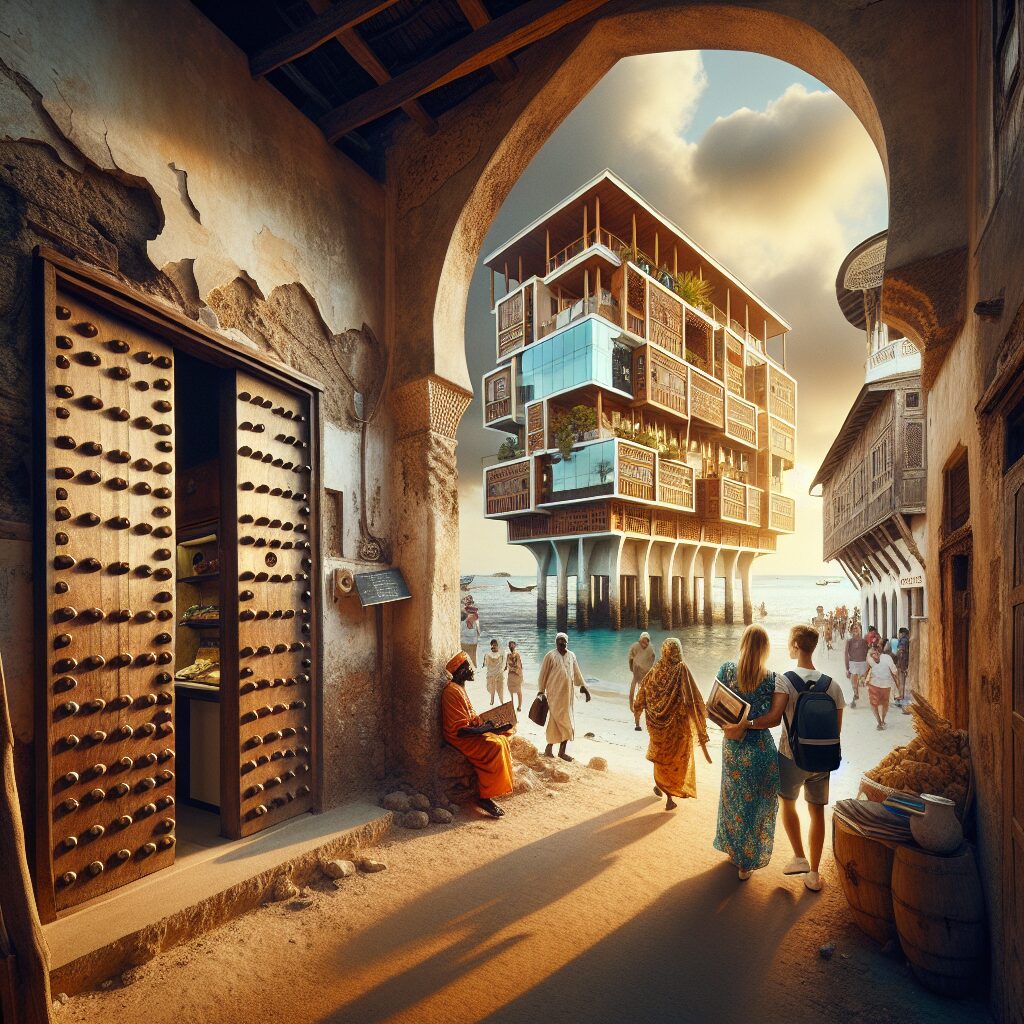
Located about forty kilometers from the Tanzanian coast, Zanzibar is not just an island: it is a meeting point. For more than a thousand years, Arab navigators, Indian merchants, European explorers, and Bantu peoples have left their mark here. This cultural mosaic can be read in the architecture of Stone Town, inscribed on the UNESCO World Heritage List, where carved balconies stand alongside studded doors and century-old mosques.

The Afriques newsletter
- Free & no spam
- 1 email per day
- Unsubscribe in 1 click
“Here, every stone tells a story,” says Salma, a 34-year-old local guide. “But what visitors don’t always see is that we still live with these stories.”
The Swahili language, traditional attire, lively fish markets — all of this bears witness to a strong identity. Yet this distinctiveness is today being tested by rapid modernization, driven by a booming tourism industry.
A tourism boom with many faces
In 2023, Zanzibar welcomed more than 620,000 international tourists, a figure up 35% compared to the previous year, according to the Tanzania Tourism Board. White sandy beaches, turquoise waters, and luxury hotels attract travelers from around the world, particularly from Europe, Asia, and the Gulf.
“We have never seen so many visitors,” says Juma, the owner of a guesthouse in Nungwi. “It is good for the economy, but it also changes the way we live.”
The tourism sector now accounts for more than 30% of Zanzibar’s GDP. New resorts are springing up in the north and east of the island, often built by foreign investors. While some employ locals and respect the environment, others raise concerns: land pressure, coastal pollution, and cultural erosion.
“Sometimes I feel like we are becoming extras in our own setting,” whispers Amina, a craftsperson in Stone Town.
Youth between heritage and new aspirations
In Zanzibar’s schools, children still learn Swahili poems and tales of the sultans. But on smartphones, it is the influencers from Dubai or Paris who fuel their dreams. Zanzibari youth stand at a crossroads.
“I am proud to be Zanzibari, but I also want to succeed, travel, and build my brand,” explains Hamisi, 22, who sells clothing inspired by the traditional kitenge style on Instagram.
The local government is trying to reconcile both worlds. Programs encourage local entrepreneurship in tourism, language training, and the promotion of artisanal know-how. But resources remain limited, and the temptation to give in to imported models is growing.
“We must not let our culture become a mere attraction,” warns Professor Bakari, a historian at the University of Zanzibar. “It must continue to live, to evolve, but according to our own choices.”
A fragile ecological balance
Beyond culture, it is also Zanzibar’s natural environment that is being put to the test. Coral reefs, which are home to hundreds of marine species, are threatened by climate change, as well as by certain unregulated tourism practices.
“Diving boats sometimes drop anchor on the corals, and the overcrowding of certain sites weakens the ecosystem,” explains Fatma, a marine biologist in Jambiani.
Local initiatives are emerging to raise awareness among visitors and operators: eco-tours, beach clean-ups, and bans on single-use plastics. But the pressure remains high, particularly in the most popular areas.
“Tourism can be a blessing or a curse — it all depends on how it is managed,” sums up Ali, a fisherman in Matemwe.
Traditions that resist, sometimes in silence
In the inland villages, far from the resorts and organized tours, life follows a different rhythm. Women prepare pilau in steaming pots, men chat in the shade of mango trees, and children play bao, an ancestral game.
“We are not against change,” says Mzee Hassan, the elder of the village of Kizimkazi. “But we want it to respect who we are.”
Some rites remain intact: traditional weddings, Eid celebrations, ngoma dances. Others are adapting, such as dhow (traditional boat) ceremonies, now offered to curious tourists. It is in this tension between preservation and adaptation that Zanzibar’s cultural future is being shaped.
Towards a new vision of tourism?
Faced with these challenges, another path seems possible. Young entrepreneurs, local NGOs, and even some hoteliers are betting on a more ethical form of tourism: community-based circuits, community accommodations, and respectful immersive experiences.
“We don’t just want to show our island — we want to share it,” says Leila, co-founder of “Zanzibar Roots,” an agency that offers homestay experiences.
The Tanzanian government, for its part, has launched a strategic plan for “sustainable tourism by 2030,” with clear objectives: limiting uncontrolled construction, promoting local products, and protecting natural sites.
But the road is long, and the tensions between economic interests, ecological imperatives, and respect for traditions remain intense.
As the waves continue to lap at Zanzibar’s pristine beaches, one question persists: will the island manage to stay true to its soul while welcoming the entire world?