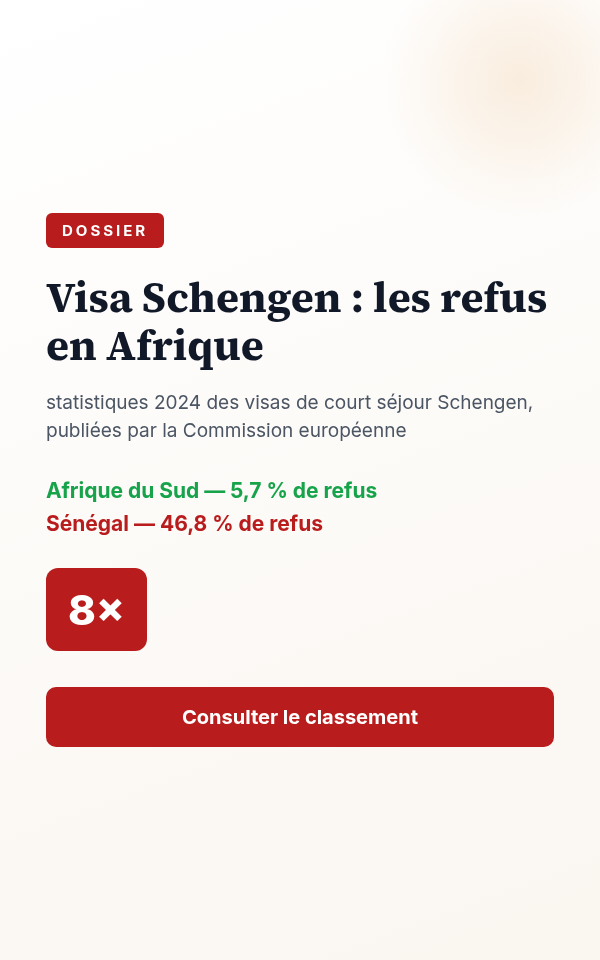

A rejection rate of 46.8% for Senegal versus 5.7% for South Africa — an eightfold gap between two African nations applying for the same Schengen short-stay visa. That disparity, buried inside the European Commission’s 2024 short-stay visa statistics, tells a story that every African traveller, diaspora member and inbound investor needs to understand. Les Afriques has ranked all 16 African countries for which comparable data are available.
Methodology
This ranking draws exclusively on the European Commission’s 2024 Schengen short-stay visa statistics, the official dataset published by the EU’s Directorate-General for Home Affairs. The single metric used is the refusal rate — the share of lodged applications that resulted in a visa being denied — recorded for 16 African countries. No figures have been extrapolated or adjusted.
A word of caution. These numbers are a snapshot for the reference year 2024. Rates shift with diplomatic relations, consular capacity, application volumes and policy changes on both sides. The ranking is designed to surface structural gaps between countries, not to predict any individual applicant’s outcome. National averages also mask significant variation by consulate, city and applicant profile.
The Afriques newsletter
- Free & no spam
- 1 email per day
- Unsubscribe in 1 click
The Full Ranking: 16 African Countries by Schengen Visa Refusal Rate (2024)
| Rank | Country | Refusal Rate |
|---|---|---|
| 1 | Senegal | 46.8% |
| 2 | Nigeria | 45.9% |
| 3 | Ghana | 45.5% |
| 4 | Congo (Brazzaville) | 43.0% |
| 5 | Cameroon | 38.1% |
| 6 | Algeria | 35.0% |
| 7 | Côte d’Ivoire | 33.8% |
| 8 | Mauritania | 32.5% |
| 9 | DR Congo | 29.9% |
| 10 | Kenya | 29.2% |
| 11 | Angola | 28.9% |
| 12 | Egypt | 25.7% |
| 13 | Tunisia | 21.7% |
| 14 | Morocco | 20.1% |
| 15 | Cape Verde | 13.4% |
| 16 | South Africa | 5.7% |
Source: European Commission, 2024 Schengen short-stay visa statistics.
Three Numbers That Frame the Problem
1. €60 million (approximately $68 million) lost to non-refundable visa fees
According to the source data, 45 African countries collectively forfeited €60 million (roughly $68 million) in non-refundable Schengen visa application fees in 2024 — representing 41% of the total worldwide revenue generated from rejected applications. That is an extraordinary transfer of wealth: applicants pay the standard €90 (approximately $98) fee regardless of outcome, and the money is not returned when a visa is denied.
2. Nearly one application in two rejected at the top of the table
Senegal (46.8%), Nigeria (45.9%), Ghana (45.5%) and Congo-Brazzaville (43%) all sit above the 40% threshold — meaning that for every ten applications lodged from these countries, more than four are turned down. For Nigeria and Ghana in particular, two of West Africa’s largest economies and home to some of the continent’s most significant diaspora communities in the UK and the US, these figures represent a structural barrier to business travel, family reunification and cultural exchange. Kenya, often cited as East Africa’s economic gateway, records a 29.2% refusal rate — still nearly one in three applications rejected. South Africa, at 5.7%, is the clear outlier: its rate is closer to those of many middle-income countries outside Africa than to the continental norm.
3. The poorest countries pay the most to be told no
The correlation between national income and refusal rate runs through the entire table. As analyst Marta Foresti is quoted in the source as putting it: “the poorest countries are paying the richest countries for the privilege of not getting a visa.” North African and southern African economies — Morocco (20.1%), Tunisia (21.7%), Egypt (25.7%), Cape Verde (13.4%) and South Africa (5.7%) — cluster at the more favourable end of the table, reflecting stronger bilateral ties, higher per-capita incomes or specific mobility arrangements with the EU.
What This Means for Investors, Diaspora and Expats
For the African diaspora in London, Paris, New York or Toronto, these numbers matter when sponsoring family visits or facilitating business delegations from home. A Nigerian or Ghanaian entrepreneur seeking to attend a trade fair in Germany faces almost even odds of being refused — a risk that shapes decisions about where to route business partnerships and which markets to prioritise.
For investors and multinational managers, high refusal rates signal friction in talent mobility. When a Senegalese or Cameroonian executive cannot reliably obtain a visa to attend board meetings or sign contracts in Europe, the cost is absorbed by the business — in delayed deals, rerouted travel and lost opportunities. The €60 million ($68 million) fee burden is a direct, quantifiable drag on African corporate budgets.
The contrast with South Africa’s 5.7% rate is instructive. South African passport holders benefit from a relatively robust bilateral relationship with the EU and a consular processing environment that reflects higher average approval rates — a reminder that refusal rates are as much a function of diplomatic architecture as of individual application quality.
Frequently Asked Questions
Where do these figures come from?
All data originate from the European Commission’s official 2024 Schengen short-stay visa statistics, published by the Directorate-General for Home Affairs. Every figure is traceable to the primary source and corresponds to the 2024 reference year.
Why only 16 countries and not all 54 African states?
The European Commission publishes disaggregated refusal-rate data only for countries where application volumes are sufficient to produce statistically comparable figures. Countries not covered by the source are not represented here.
Does my individual chance of getting a visa match my country’s rate?
No. These are national averages. Your personal outcome depends on your specific documentation, financial profile, travel history, the consulate you apply through and other individual factors. The ranking identifies structural patterns, not individual probabilities.
Source: European Commission, 2024 Schengen short-stay visa statistics. This dossier is for informational purposes only and does not constitute legal or immigration advice. For corrections or methodology questions: [email protected].

Moussa D.
Editor-in-chief of lesafriques.com. An economic journalist trained in Tunis, he sets the editorial line and reviews every article before publication. He ensures every figure is sourced, verified and dated, in line with the site's methodology.
View all articles → · LinkedIn ↗