
Africa’s instant payment infrastructure has expanded at a pace that few predicted five years ago. In 2025, the continent’s 39 operational instant payment systems processed 71.4 billion transactions valued at $1.8 trillion — nearly three times the volume recorded in 2021. Transaction volumes have grown at an average of 28% a year. Yet the headline numbers obscure a stubborn friction point: millions of users who can pay digitally still choose not to, and the reason is trust, not access.
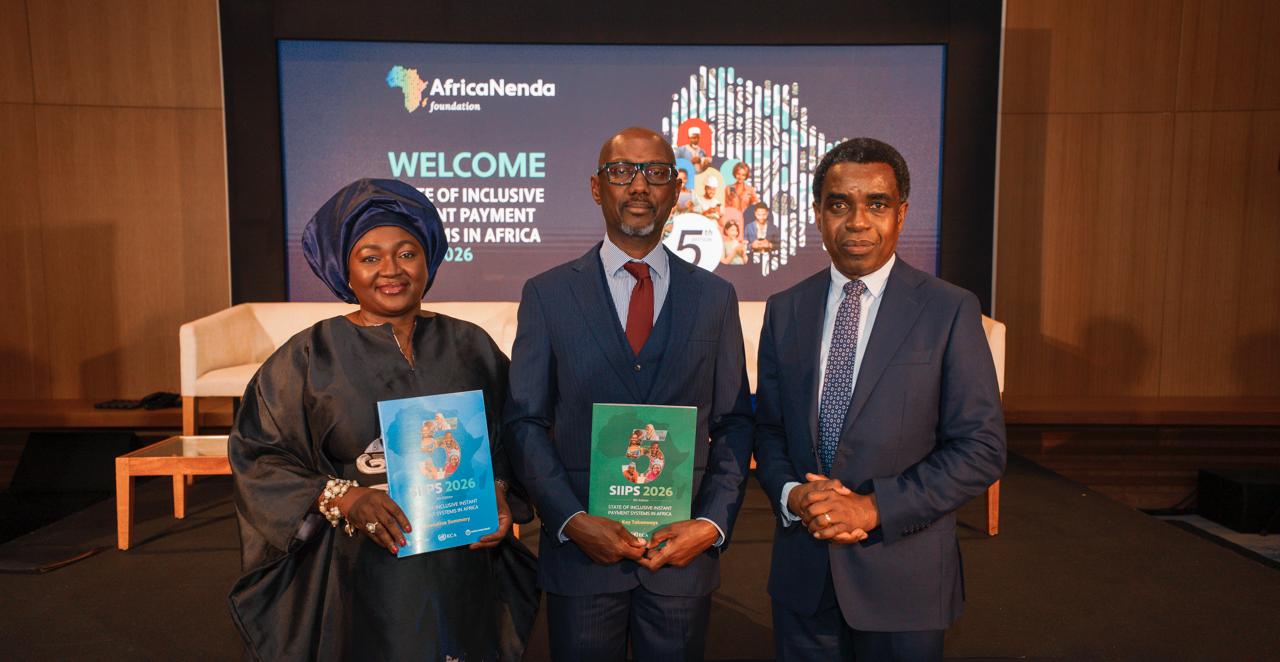
These are the central findings of the 2026 State of Inclusive Instant Payment Systems in Africa (SIIPS) report, published by the AfricaNenda Foundation in partnership with the United Nations Economic Commission for Africa (UNECA) and the World Bank Group. The report was launched on 19 November 2026 in Mauritius.
Key Figures: SIIPS 2026
| Indicator | Value (2026) |
|---|---|
| Operational instant payment systems | 39 (35 national + 4 regional) |
| Countries with instant payment access | 43 |
| Transactions processed in 2025 | 71.4 billion |
| Transaction value in 2025 | $1.8 trillion |
| Average annual volume growth | +28% per year since 2021 |
| Average transaction amount | $45 (2022) → $26 (2026) |
| Mobile money share of volume | 73% |
| Adults living in a covered country | 89% |
The Infrastructure Story: 43 Countries, Four Regional Corridors
Africa now has 35 national instant payment infrastructures across 29 countries, plus 4 regional systems, giving a total of 43 countries with some form of instant payment access. Four new national systems went live in the past year alone — in Liberia, Burundi, Guinea and Mauritania — and a new regional infrastructure now connects the eight member states of the West African Economic and Monetary Union. A further 17 countries have projects under active development.

The Afriques newsletter
- Free & no spam
- 1 email per day
- Unsubscribe in 1 click
The four live regional systems are PAPSS (pan-African), TCIB (covering six SADC countries), GIMAC-P (covering six CEMAC countries in Central Africa), and PSPI (covering the eight UEMOA countries in West Africa). Three more regional corridors — for the East African Community, COMESA, and ECOWAS — are in development. AfricaNenda’s stated goal, according to lead author Sabine F. Mensah, is for every African country to have an inclusive instant payment system by 2030.
“Five years ago, our first report counted 29 instant payment infrastructures in Africa. Today there are 39, and one in two adults lives in a country with an inclusive instant payment infrastructure,” Mensah, Deputy CEO of AfricaNenda Foundation, said at the launch. That 89% of African adults now live in a country with any form of instant payment system is a coverage figure worth noting for investors and policymakers — though coverage and active usage are, as the report makes clear, two very different things.
The Trust Deficit: Cash Still Wins Half the Battle
AfricaNenda commissioned a consumer study covering 1,403 digital payment users across 15 African markets — the first of its kind to draw on five years of transaction data. The findings are sobering for anyone betting purely on infrastructure rollout to drive adoption.
55% of surveyed users still pay for at least half of their transactions in cash. More than half have experienced payment failures — delays, transfers sent to the wrong recipient. Perhaps more concerning for system operators: one third of users who encountered problems never reported the incident, suggesting a silent churn that standard complaint data would miss entirely.
The consequences are asymmetric and financially significant. 43% of users who lost money reduced their use of digital payments afterward. By contrast, users who received a refund after a problem often increased their usage. The implication, which the report spells out directly, is that dispute resolution is not a customer-service footnote — it is a growth lever.
Mensah told Les Afriques in an interview the day before the launch: “Trust is the most recurring barrier to regular use of digital payments.” She identified three features that AfricaNenda recommends making mandatory across all systems: the ability to verify the beneficiary’s identity before sending; immediate execution within seconds; and a real-time confirmation message showing both the amount and the recipient. These are not exotic technical requirements — they are table stakes that several systems still do not consistently deliver.
Smaller Tickets, Broader Reach
One data point that cuts against a purely pessimistic reading: the average transaction amount has fallen from $45 in 2022 to $26 in 2026. For mobile money specifically, the average dropped from $17 to $9 over the same period. Mobile money already accounts for 73% of total transaction volume across the continent.
Mensah frames this decline as genuinely positive. Smaller average amounts mean that more everyday, low-value transactions — the kind previously paid in cash — are being digitised. For the unbanked, each digitised transaction builds a credit history. For small and medium-sized businesses, it creates financial visibility. For governments, it widens the formal tax base. The drop in ticket size is, in this reading, a signal of deepening rather than shrinking usage.
The report’s impact analysis — described as the first longitudinal study of its kind using five years of transaction data — found that in countries with an operational instant payment infrastructure, the share of actively used accounts is roughly 7 percentage points higher than in countries without one. That gap is a credible argument for continued public and private investment in infrastructure, while also confirming that infrastructure alone does not close the adoption gap entirely.
Stablecoins: Niche Today, Signal for Tomorrow
The 2026 report introduces a section on stablecoins that earlier editions did not need to address. The assessment is measured: stablecoins do not yet compete meaningfully with regional instant payment systems, but their emergence signals genuine, unmet demand for low-cost, 24/7 cross-border settlement.
Two of Africa’s largest economies have moved in this direction. South Africa launched OSARU, a rand-backed stablecoin, in 2026. Nigeria has a naira-backed stablecoin in development through a consortium of banks and fintechs. On the regulatory side, Mauritius established a virtual assets framework in 2021; Namibia passed a Virtual Asset Act in 2023; and Botswana, Uganda, Tanzania, Zambia and Zimbabwe have published regulatory orientations. The report does not project adoption timelines or market share figures for stablecoins — those numbers are not yet established — but the regulatory momentum suggests the asset class will be harder to ignore in the SIIPS 2027 edition.
The AfCFTA Multiplier
Running beneath all of this is the unresolved question of intra-African trade finance. The African Continental Free Trade Area (AfCFTA) theoretically opens a combined market of more than 1.5 billion people to African micro, small and medium enterprises — a figure Mensah cited directly in her interview. Instant payment infrastructure is a necessary, if not sufficient, condition for those businesses to transact across borders without routing payments through correspondent banking networks in London or New York. The four live regional systems are a start. Whether they will be interoperable, affordable and trusted enough to serve SMEs at scale by the time AfCFTA’s trade protocols are fully operational is the defining infrastructure question of the next decade.
Dr Robert Ochola, CEO of AfricaNenda Foundation, was direct about what comes next: “Africa has built inclusive instant payment infrastructures at remarkable speed, drawing on the skills of its own software engineers and designers. The next five years must be devoted to making these systems affordable, safe and viable over the long term.”
Frequently Asked Questions
How does Africa’s instant payment growth compare to other emerging markets?
The SIIPS 2026 report does not benchmark Africa against Asia or Latin America directly. What the data shows is a 28% average annual volume growth since 2021 — a rate that most payment industry observers would consider rapid by any global standard. India’s UPI, for context, is a widely cited benchmark for high-volume instant payment systems, but the African picture is more fragmented across 39 separate infrastructures rather than a single national system.
Which countries are still without instant payment access?
According to the report, 43 African countries now have access to instant payments, leaving a minority of the continent’s 54 recognised states without coverage. Seventeen countries have projects under development. The report does not name the remaining countries without any system or active project.
What does the falling average transaction amount mean for mobile money operators?
Lower average amounts typically mean thinner per-transaction revenue if fees are percentage-based, and more volume needed to maintain margins. However, the report’s framing — that smaller tickets reflect deeper digitisation of everyday spending — suggests the addressable market is growing even as individual transaction values shrink. Fee structure and interoperability costs will determine which operators benefit.
Where can investors and researchers access the full report?
The full SIIPS 2026 report is available on the AfricaNenda website.
Source: AfricaNenda Foundation, SIIPS 2026 report, press release and interview with Sabine F. Mensah, 18–19 November 2026.