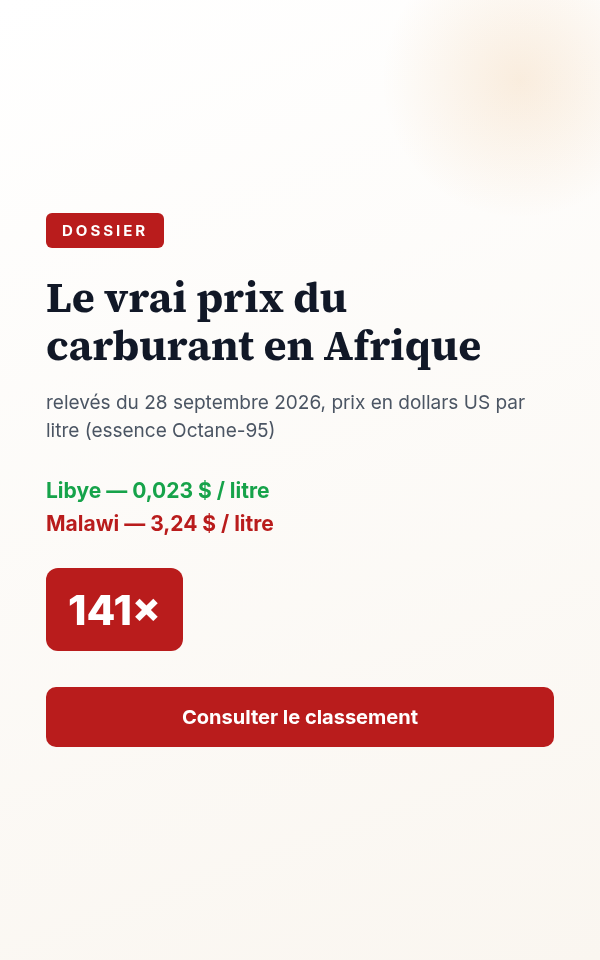

Libya sells petrol at $0.023 per litre. Malawi charges $3.23. That is a 140-fold difference between two African countries — and it has almost nothing to do with geography. Drawing on GlobalPetrolPrices data recorded on 12 October 2026, Les Afriques has ranked 41 African nations by the pump price of Octane-95 gasoline, expressed in US dollars per litre. The result is a stark map of subsidy politics, currency crises and landlocked logistics — details that matter whether you are running a business, sending money home or evaluating an investment.
Methodology
All figures come from GlobalPetrolPrices, snapshot dated 12 October 2026. The metric is straightforward: the retail price of Octane-95 gasoline in US dollars per litre. Forty-one African countries are covered — those for which comparable, traceable data were available. The remaining African Union member states were not captured in the source dataset and are therefore excluded. A higher figure means a more expensive pump price for the end consumer.

The Afriques newsletter
- Free & no spam
- 1 email per day
- Unsubscribe in 1 click
These are reference values, not predictions. Prices shift with crude markets, exchange-rate moves, subsidy reforms and local tax changes. Crowdsourced or averaged figures can also mask significant intra-country variation — rural versus urban, formal versus informal market. Use this ranking to identify structural gaps between countries, not to forecast a precise price at a specific forecourt.
Full Ranking: 41 African Countries by Petrol Price (Oct. 2026)
| Rank | Country | Price (USD / litre) |
|---|---|---|
| 1 | Libya | $0.023 / litre |
| 2 | Angola | $0.327 / litre |
| 3 | Algeria | $0.35 / litre |
| 4 | Egypt | $0.46 / litre |
| 5 | Sudan | $0.70 / litre |
| 6 | Tunisia | $0.84 / litre |
| 7 | Niger | $0.854 / litre |
| 8 | Nigeria | $0.98 / litre |
| 9 | Gabon | $1.016 / litre |
| 10 | Ethiopia | $1.04 / litre |
| 11 | Madagascar | $1.18 / litre |
| 12 | Benin | $1.24 / litre |
| 13 | Liberia | $1.269 / litre |
| 14 | Botswana | $1.327 / litre |
| 15 | Burundi | $1.335 / litre |
| 16 | Guinea | $1.364 / litre |
| 17 | Togo | $1.399 / litre |
| 18 | Cameroon | $1.43 / litre |
| 19 | Burkina Faso | $1.46 / litre |
| 20 | Mozambique | $1.47 / litre |
| 21 | Mauritius | $1.49 / litre |
| 22 | Mali | $1.498 / litre |
| 23 | Tanzania | $1.54 / litre |
| 24 | Côte d’Ivoire | $1.55 / litre |
| 25 | Morocco | $1.56 / litre |
| 26 | Eswatini | $1.575 / litre |
| 27 | Zambia | $1.58 / litre |
| 28 | Namibia | $1.61 / litre |
| 29 | Ghana | $1.62 / litre |
| 30 | Kenya | $1.64 / litre |
| 31 | Uganda | $1.662 / litre |
| 32 | Senegal | $1.695 / litre |
| 33 | Lesotho | $1.73 / litre |
| 34 | Seychelles | $1.788 / litre |
| 35 | Central African Republic | $1.792 / litre |
| 36 | South Africa | $1.81 / litre |
| 37 | Cape Verde | $1.99 / litre |
| 38 | Rwanda | $1.99 / litre |
| 39 | Sierra Leone | $2.03 / litre |
| 40 | Zimbabwe | $2.05 / litre |
| 41 | Malawi | $3.23 / litre |
Three Numbers That Define the Divide
1. A 140-fold gap within the same continent
Libya’s pump price of $0.023 per litre and Malawi’s $3.23 are not outliers on different continents — they sit on the same landmass, under the same African Union umbrella. The explanation is almost entirely political rather than geographic. Libya maintains one of the world’s most aggressive fuel-subsidy regimes, keeping pump prices at a near-symbolic level. Malawi, by contrast, operates with minimal subsidy support and has seen its kwacha under sustained pressure, pushing import costs — and therefore pump prices — sharply higher.
2. Subsidies, not oil wealth, set the price floor
The five cheapest markets in this ranking are all either oil producers or heavy state subsidisers: Libya ($0.023), Angola ($0.327), Algeria ($0.35), Egypt ($0.46) and Sudan ($0.70). At the other end, the five most expensive markets — Malawi ($3.23), Zimbabwe ($2.05), Sierra Leone ($2.03), Rwanda ($1.99) and Cape Verde ($1.99) — share a different profile: landlocked logistics penalties, chronic foreign-currency shortages, or island-state import premiums, without the cushion of subsidy. For investors and logistics operators, this spread directly feeds into freight costs, agricultural input costs and manufacturing overheads across the continent.
3. Africa’s largest market economies cluster in the middle
Nigeria, at $0.98 per litre, ranks 8th — still relatively affordable by African standards, though a far cry from the near-zero prices that prevailed before successive subsidy reforms. The continent’s other major benchmark economies — Ghana ($1.62, rank 29), Kenya ($1.64, rank 30), Morocco ($1.56, rank 25) and South Africa ($1.81, rank 36) — are bunched tightly between $1.50 and $1.85, broadly reflecting unsubsidised or lightly managed market pricing. For diaspora members sending remittances to these countries, and for multinationals with regional hubs there, this mid-table pricing zone represents something close to a true economic cost of energy.
“A litre of petrol costs $0.023 in Libya and $3.23 in Malawi — a 140-fold difference between two African countries, according to GlobalPetrolPrices (October 2026).”
— Les Afriques data desk
What This Means for Investors, Expats and the Diaspora
Fuel prices are a proxy for a country’s broader cost structure. Cheap fuel — where it reflects genuine state subsidy — suppresses transport and logistics costs in the short term but creates fiscal risk and subsidy-reform exposure, as Nigeria’s own difficult reform journey illustrates. Expensive fuel, as seen in Malawi or Zimbabwe, signals wider macroeconomic stress: currency depreciation, thin foreign-exchange reserves and weak state finances. For anyone evaluating where to place capital, source goods or base regional operations, this ranking offers a useful first filter. Combine it with purchasing-power data and you get a sharper picture still: $1.64 per litre in Kenya lands differently on a household budget than the same price in South Africa.
Frequently Asked Questions
Where do these figures come from?
All data are sourced from GlobalPetrolPrices, recorded on 12 October 2026. The metric is the retail pump price of Octane-95 gasoline in US dollars per litre. Every figure is traceable to the original dataset.
Why 41 countries and not all 54 African Union members?
The source dataset covers only those countries for which comparable, verified data were available at the time of collection. Countries absent from the source are not included here.
Do these prices reflect what I would actually pay at the pump?
They are reference values — national averages or representative prices — not guaranteed local forecourt prices. Rural-urban gaps, informal market premiums and intra-country variation can be significant. The ranking is designed to enable cross-country comparison and highlight structural differences, not to predict the exact price at a specific station.
How quickly do these prices change?
Fuel prices are sensitive to global crude markets, exchange-rate fluctuations and domestic policy decisions. A subsidy reform or a sharp currency move can shift a country’s ranking materially within weeks. Always verify with current local sources before making operational or investment decisions.
Errors, corrections or methodological questions: redaction@lesafriques.com
Source: GlobalPetrolPrices, 12 October 2026. This dossier is for informational purposes only and does not constitute investment or financial advice.