
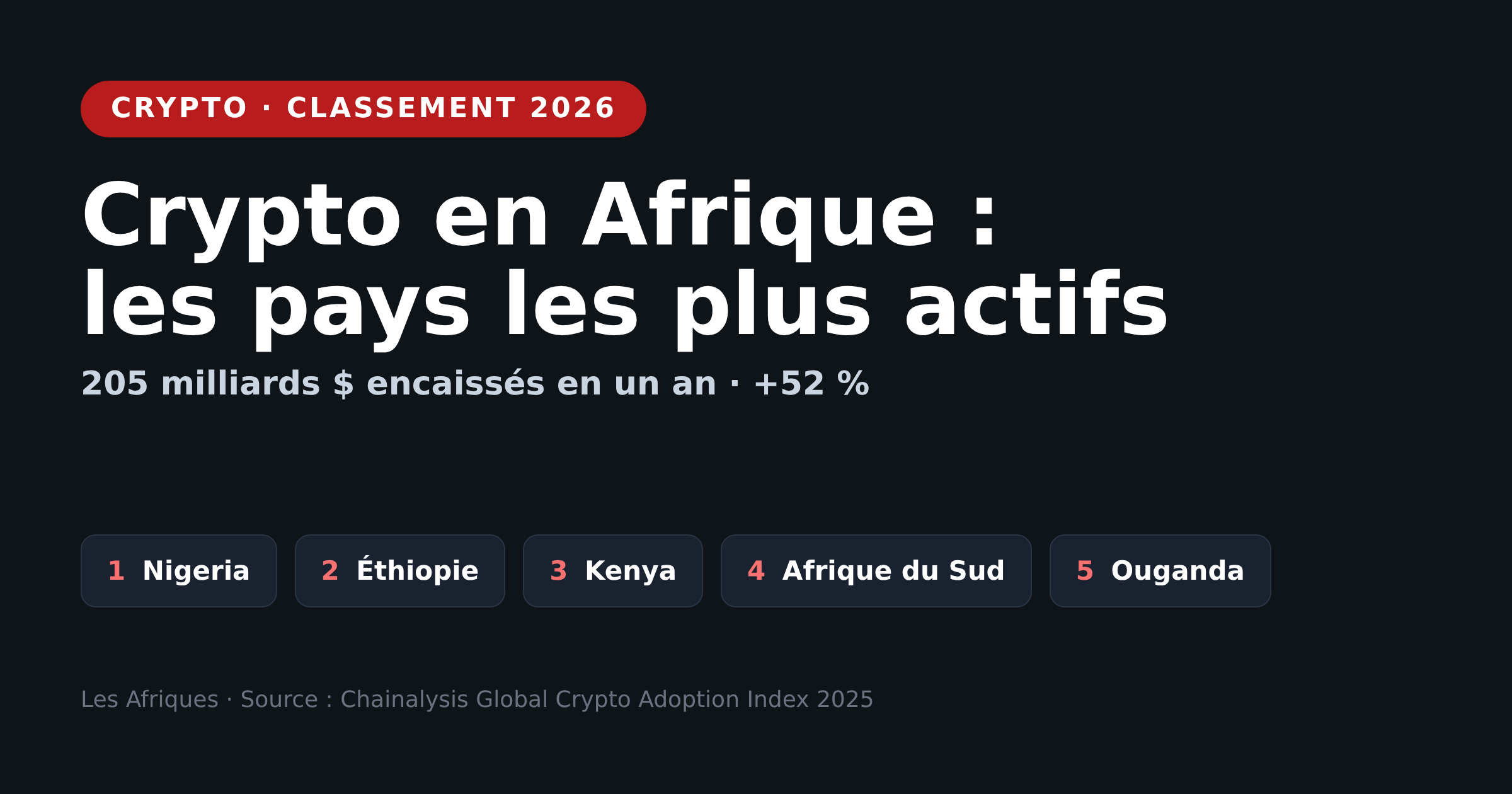
Nigeria alone received $92.1 billion in cryptocurrency over twelve months — nearly three times South Africa’s volume — while Sub-Saharan Africa as a whole pulled in $205 billion, a 52% year-on-year jump that makes it the third-fastest-growing crypto region on the planet. These are not projections or surveys: they reflect actual on-chain transactions captured by Chainalysis in its Global Crypto Adoption Index 2025, the industry’s most widely cited measure of real-world crypto use.
How the ranking works
The Global Crypto Adoption Index 2025, published by blockchain analytics firm Chainalysis, covers the period from 1 July 2024 to 30 June 2025 and ranks 151 countries across four sub-indices: retail value received on centralised services, total value received on centralised services, decentralised finance (DeFi) activity, and institutional activity. Each sub-index is weighted by population and GDP per capita at purchasing-power parity, so a country with widespread grassroots usage ranks higher than a wealthy market with only a handful of large institutional players. A rank of 1 signals the strongest adoption relative to economic size.
The Afriques newsletter
- Free & no spam
- 1 email per day
- Unsubscribe in 1 click
It is worth noting the methodology’s limits. The data captures real on-chain flows, not stated intentions — a meaningful distinction in a market full of hype. However, some traffic routed through VPNs may be misattributed geographically, introducing a degree of uncertainty. Holder counts cited below come from the Policy Center for the New South (PCNS), which recorded 55.3 million cryptocurrency holders across 33 African countries.
Five African countries in the global top 40
Africa places five countries inside the global top 40 — a striking result for a region often underestimated by international investors. Here is how they rank across all four sub-indices, out of 151 countries:
| Country | Global rank | Retail | Centralised | DeFi | Institutional |
|---|---|---|---|---|---|
| Nigeria | 6 | 7 | 8 | 3 | 8 |
| Ethiopia | 12 | 16 | 19 | 7 | 20 |
| Kenya | 25 | 22 | 21 | 32 | 21 |
| South Africa | 28 | 23 | 25 | 39 | 26 |
| Uganda | 37 | 47 | 44 | 17 | 42 |
Source: Chainalysis, Global Crypto Adoption Index 2025 (global ranks out of 151 countries).
Country by country: what the numbers reveal
Nigeria — Africa’s undisputed crypto capital
Nigeria’s $92.1 billion in crypto received over the twelve-month period is not just an African record — it places the country 6th globally, ahead of far wealthier economies. According to PCNS data cited by Chainalysis, Nigeria accounts for 40.5% of the continent’s crypto holders, approximately 22 million people. The most telling figure, however, is its DeFi rank: 3rd in the world. Nigerians are not simply buying bitcoin and holding it; they are actively engaging with decentralised protocols for borrowing, lending and trading.
The driver is structural, not speculative. Persistent naira inflation and severe restrictions on access to foreign currency have pushed millions of Nigerians toward dollar-pegged stablecoins as a store of value and a payment rail. According to the Chainalysis report, a sudden naira devaluation in March 2025 triggered a spike to nearly $25 billion in regional monthly volume — a clear signal that crypto is functioning as a currency hedge rather than a speculative asset for many users.
Ethiopia — the ranking’s biggest surprise
Ethiopia’s 12th-place global finish is the story most international observers will not have seen coming. It ranks ahead of markets with far higher internet penetration and per-capita income. Its 7th-place DeFi ranking is particularly striking: measured against the size of its economy, Ethiopia’s engagement with decentralised finance is among the most intense anywhere in the world.
According to the source, strict foreign-exchange controls and a young, increasingly connected population are key factors. The dynamic is comparable in some respects to Nigeria’s, though far less covered in English-language financial media — which makes the Chainalysis data all the more significant for investors and observers tracking frontier markets.
Kenya — mobile money meets crypto
Kenya ranks 25th globally and, according to PCNS figures, counts approximately 6 million crypto holders. Its trajectory is rooted in a foundation that no other African market can fully replicate: M-Pesa. The mobile money platform, which transformed how Kenyans handle everyday transactions, effectively pre-trained a generation of users to manage money digitally without a traditional bank account. That familiarity translates naturally into crypto adoption, particularly for cross-border transfers and payments — the use cases that dominate Kenya’s crypto activity, according to the source.
South Africa — the continent’s most regulated market
South Africa’s 28th global rank understates a different kind of leadership. According to the source, hundreds of virtual asset service providers are already licensed under its regulatory framework, making it the most institutionally mature crypto market on the continent. Large-value transactions — often driven by arbitrage between local and international prices — carry significant weight in South Africa’s overall volumes. Banks and financial institutions are actively developing custody offerings and stablecoin products. For institutional investors seeking regulatory clarity, South Africa is currently the most legible African market.
Uganda — the DeFi outsider
Uganda’s 37th global rank is carried almost entirely by its DeFi activity, where it places 17th worldwide. Its retail rank (47th) and centralised exchange rank (44th) are considerably more modest, suggesting that crypto usage in Uganda is concentrated among a smaller group of technically sophisticated users rather than the broader population. Whether that base expands into a mass-market story is one of the more interesting open questions in the region.
What is actually driving adoption
Three data points from the Chainalysis report frame the broader picture. First, 8% of transfers in Sub-Saharan Africa are below $10,000 — compared with 6% globally — confirming that adoption is being led by individuals, not large-scale institutional speculation. Second, the region’s 52% growth in crypto value received over one year places it third globally, behind Asia-Pacific (+69%) and Latin America (+63%), but ahead of every other region. Third, dollar-pegged stablecoins are increasingly being used as settlement rails for trade flows between Africa, the Middle East and Asia — multi-million-dollar transfers that bypass a banking infrastructure that is both slow and expensive.
Taken together, crypto in Sub-Saharan Africa is addressing three gaps that traditional finance has consistently failed to close: protection against inflation and currency devaluation (via stablecoins), cheaper and faster remittances (relevant to a large diaspora community in the US and UK), and access to financial services for the unbanked — still more than half of adults in Sub-Saharan Africa, according to the source.
Buy crypto in Africa
Binance — the world’s largest cryptocurrency exchange, available in most African countries.
Create a Binance account → (referral — affiliate link)
Frequently asked questions
Why does Nigeria rank so much higher than South Africa, despite South Africa having a larger formal financial sector?
The Chainalysis index weights adoption relative to population and economic size, not in absolute dollar terms per capita. Nigeria’s sheer scale of grassroots usage — driven by naira instability and foreign-currency restrictions — produces a rank (6th globally) that reflects intensity of real-world need. South Africa’s more affluent, banked population has less structural pressure to use crypto as a currency substitute, even though its institutional framework is more advanced.
Are these figures measuring bitcoin specifically, or all crypto activity?
All crypto activity. The index aggregates value received on centralised exchanges (retail and institutional) and DeFi protocol activity. According to the source, dollar-pegged stablecoins — used for transfers, savings and trade settlement — represent a substantial share of the volumes, likely outweighing bitcoin in many of these markets.
How reliable is the geographic attribution of these transactions?
The Chainalysis methodology is based on actual on-chain data, which is more rigorous than survey-based estimates. However, the source itself flags a margin of uncertainty: traffic routed through VPNs can be misattributed to the wrong country. The broad rankings are considered robust; individual country figures should be read as directional rather than precise.
What does this mean for investors looking at African markets?
The data suggests that crypto infrastructure — exchanges, stablecoin rails, DeFi protocols — is becoming embedded in everyday economic life across multiple African markets simultaneously. For investors, the pattern points to growing demand for dollar-denominated digital assets, cross-border payment infrastructure and regulated custody services. South Africa offers the clearest regulatory entry point today; Nigeria offers the largest user base; Ethiopia and Uganda represent earlier-stage but fast-moving opportunities. None of that constitutes investment advice — due diligence on local regulatory status remains essential.
Source: Chainalysis, The 2025 Geography of Cryptocurrency Report (July 2024 – June 2025); Policy Center for the New South (PCNS). Data is indicative and subject to revision. This article does not constitute investment advice.