
Buying cryptocurrency in Africa is possible in virtually every country on the continent — but the mechanics look nothing like what a user in New York or London would expect. In most African markets, peer-to-peer (P2P) trading, where individuals transact directly rather than buying through a centralised order book, is the dominant route. Nigeria and South Africa are the most mature markets, but from Senegal to Angola, platforms have wired themselves into mobile money networks to reach users who have never held a traditional bank card. Here is the 2026 breakdown, country by country.
The Main Platforms Operating Across Africa
| Platform | Coverage | Payment Methods | Fees |
|---|---|---|---|
| Binance P2P | Almost all countries | Mobile money, bank transfer, 100+ methods | 0% (seller spread applies) |
| Yellow Card | 20+ countries | Mobile money, bank transfer, card | 1.5 – 2% |
| Noones (formerly Paxful) | 50+ countries | 300+ methods | 0.5 – 1% |
| Quidax | Nigeria | Bank transfer, naira | 0.5% |
| Luno | South Africa, Nigeria | Bank transfer | 0.1 – 1% |
Sources: platform guides 2026. P2P dominates because it routes around local banking restrictions that make card-based purchases difficult or blocked.

The Afriques newsletter
- Free & no spam
- 1 email per day
- Unsubscribe in 1 click
Country-by-Country Breakdown
Nigeria
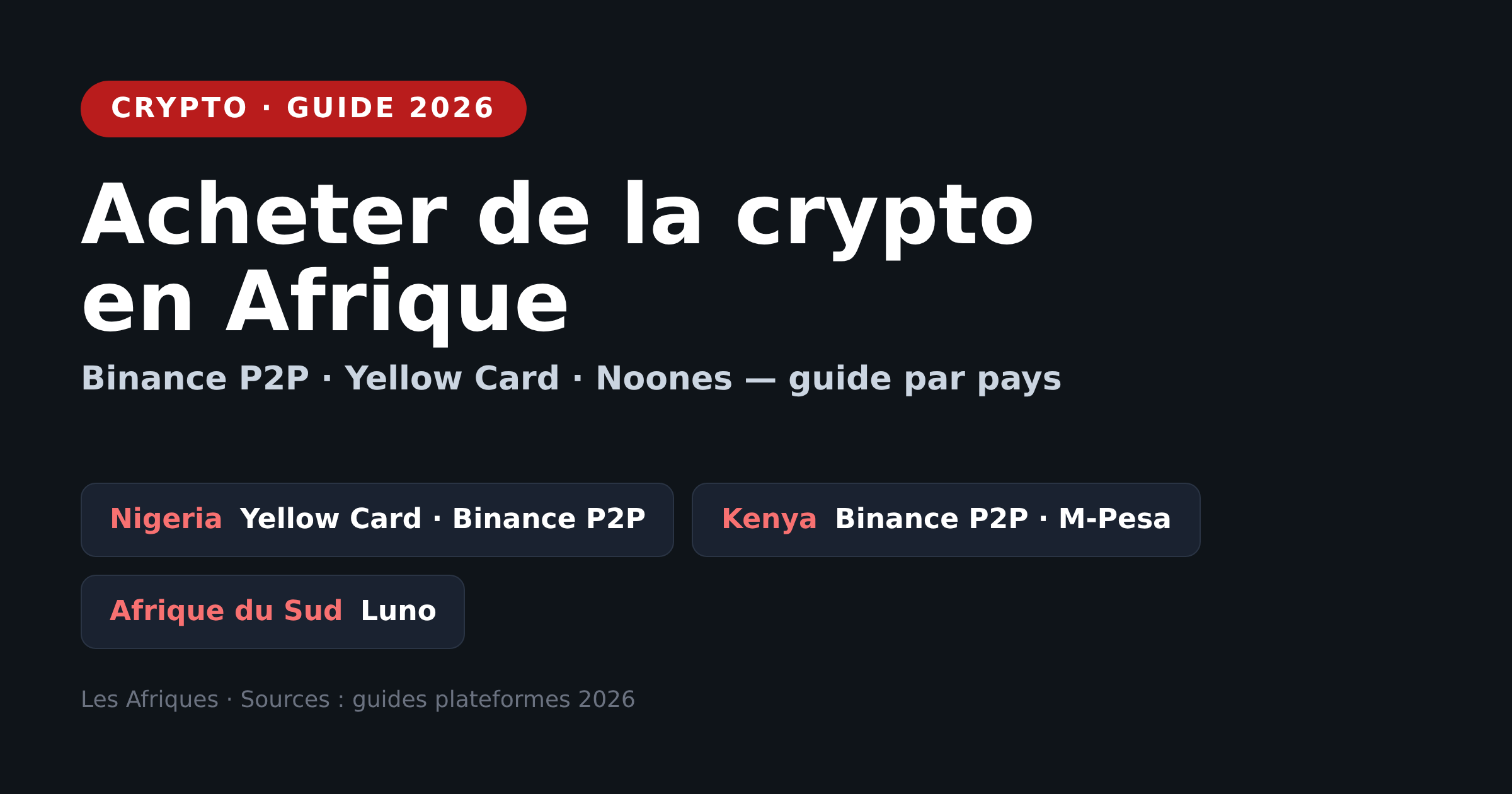
Africa’s most active crypto market by volume. For a first-time buyer, Yellow Card is the most straightforward entry point — deposits accepted in naira via OPay or standard bank transfer. Binance P2P offers the deepest liquidity on the continent. Quidax, at 0.5% fees, is a locally built alternative worth considering. Crypto is legal in Nigeria and regulated by the Securities and Exchange Commission (SEC).
South Africa
The most tightly regulated market on the continent, with hundreds of licensed crypto asset service providers. Luno — a platform with South African roots — is the default choice for buying directly in rand. For diaspora investors or foreign-currency holders, South Africa’s regulatory framework is the most legible on the continent.
Kenya
Most purchases flow through Binance P2P, funded via M-Pesa — the mobile money infrastructure that Kenya pioneered and that remains the most widely used on the continent. Crypto is legal in Kenya and the sector is growing fast, making it a natural point of comparison for mobile-first crypto adoption across East Africa.
Ghana
Binance P2P paired with MTN MoMo or Vodafone Cash is the primary route. The Bank of Ghana is progressively building out a regulatory framework for the sector, though clear guidelines remain a work in progress.
Côte d’Ivoire
Binance P2P is the strongest option, with deep liquidity in FCFA (XOF) and support for Orange Money, MTN MoMo, and Wave. Yellow Card offers a simpler onboarding experience for users buying crypto for the first time.
Senegal
The same model applies: Binance P2P via Orange Money or Wave. The absence of a major regulated local exchange means P2P remains the primary channel — a pattern common across francophone West Africa.
Cameroon
Binance P2P with MTN MoMo is the main route. Notably, the CEMAC zone — the six-country Central African economic and monetary union — reportedly adopted a regulation in 2026 that officially recognises crypto platforms as financial intermediaries. According to the source, this framework is still being implemented.
Angola
Binance P2P, funded via Multicaixa Express or bank transfer in kwanzas, is the available route. Angola has not yet established a comprehensive regulatory framework: P2P activity is not explicitly prohibited, but buyers operate without clear legal protection — a meaningful risk that investors should weigh carefully.
How a P2P Purchase Actually Works
The process is largely identical across all these markets. A user creates an account on the chosen platform, completes identity verification (KYC — the depth of which varies by platform and trade size), selects a P2P offer that matches their preferred payment method — mobile money or bank transfer — pays the seller directly, and receives the crypto in the platform’s built-in wallet. The critical safeguard is an escrow mechanism: the seller’s crypto is locked by the platform until the buyer confirms payment has been sent. That escrow removes the need for either party to trust the other blindly.
For broader context on why Africa is one of the fastest-growing crypto regions globally, see our ranking of Africa’s most active crypto countries.
Buy crypto in Africa
Binance — the world’s largest cryptocurrency exchange, available in most African countries.
Create a Binance account → (referral — affiliate link)
Frequently Asked Questions
Which platform offers the best overall coverage across Africa?
According to the 2026 platform guides cited by this source, Binance P2P offers the widest country coverage and the greatest number of payment methods. Yellow Card is rated as the most beginner-friendly option, particularly in Nigeria. Luno remains the default in South Africa for direct rand purchases.
Why P2P rather than a straightforward card purchase?
Local banking restrictions and the scarcity of regulated exchanges in most African markets make card-based crypto purchases difficult or outright blocked. P2P lets buyers pay in their local currency — naira, FCFA, kwanzas — via mobile money or bank transfer, without needing an internationally enabled card.
Is crypto legal in these countries?
In Nigeria (SEC-regulated), South Africa (licensed provider framework), and — according to this source — the CEMAC zone (under its 2026 regulation), crypto operates within a recognised legal structure. In other markets covered here, crypto is generally practised without an explicit ban but also without clear legal protection. Regulatory status can change quickly; verify the current position in your specific country before committing funds.
Is identity verification (KYC) always required?
In almost all cases, yes. The threshold varies: Yellow Card and Luno require government-issued ID from the outset, while Binance P2P and Noones may allow lighter verification for smaller trade sizes. Higher volumes will typically trigger full KYC on every platform.
Disclaimer: This content is informational only and does not constitute investment advice. Cryptocurrencies are volatile assets; values can fall as well as rise.
Source: Platform guides 2026 (Bitcoin Africa, Binance/Yellow Card/Noones documentation), national regulatory frameworks, 2026.