


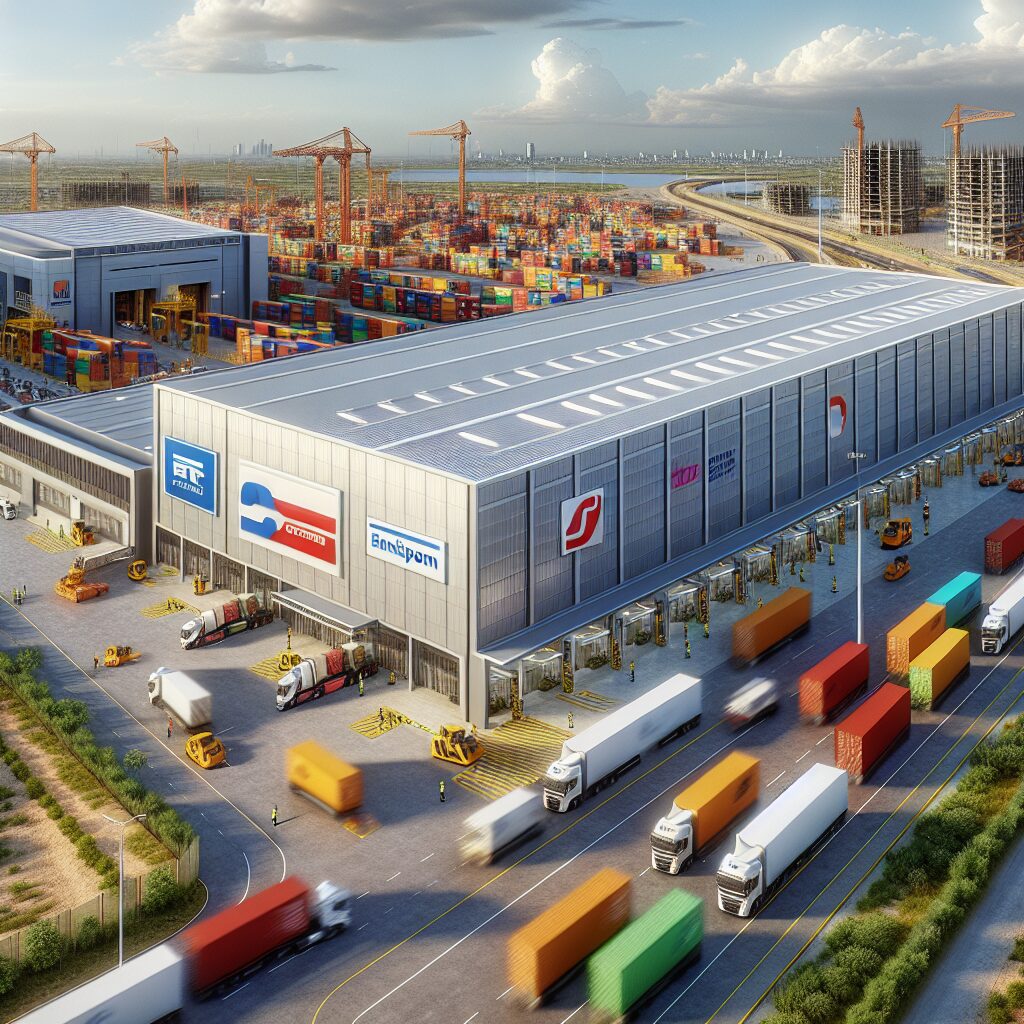
At dusk, cranes are still busy at the port of Lomé. Containers stack up, trucks file past, lights pierce the salty haze of the Gulf of Guinea. Something is changing. Quietly, but irresistibly, certain African cities are transforming into nerve centers of global trade. Logistics hubs where everything converges, everything passes through, everything accelerates.
A geography reshaping flows
Long considered peripheral in global trade, Africa is now seeing its lines shift. Demographic growth, massive infrastructure investments and the rise of intra-African trade are reshuffling the cards. And certain strategically located cities are emerging as regional hubs.
“We understood that our geographical position is an asset, not a fate,” explains Aminata Diop, urban planner in Dakar. “By strengthening our ports, roads and logistics platforms, we are becoming a bridge between continents.”
The Abidjan-Lagos corridor, nearly 1,000 km long, alone concentrates more than 75 million inhabitants and generates 60% of the GDP of the Economic Community of West African States (ECOWAS). This urban density, combined with maritime proximity, attracts giants in transport and distribution.
Lomé, the quiet rising star
Little covered by the media, the Togolese capital has nonetheless established itself as a major logistics player in West Africa. Its deep-water port, modernized in 2014, operates 24 hours a day, 24 days a week and welcomes ships over 300 meters long. It is today the only deep-water port in the sub-region not hampered by sandbanks or unpredictable tides.
With more than 1.6 million TEUs (twenty-foot equivalents) processed in 2023, Lomé now surpasses its historic neighbors such as Cotonou or even Abidjan. The port has become a transshipment hub for the region, serving Burkina Faso, Niger and Mali.
“Before, our goods took weeks to arrive. Today, they pass through Lomé and arrive in a few days,” says Ibrahim Traoré, an importer in Ouagadougou. “It’s a silent revolution.”
Nairobi, at the heart of East African trade
Thousands of kilometers away, Nairobi is establishing itself as the gateway to East Africa. Connected to the port of Mombasa by a modern railway line, the Standard Gauge Railway, the Kenyan capital attracts warehouses, distribution centers and regional headquarters of multinationals.
Amazon, Maersk, DHL: they all now have a base there. The Nairobi Inland Container Depot, a vast logistics platform located south of the city, processes more than 500,000 containers per year. It helps to relieve congestion in Mombasa while bringing goods closer to consumption areas.
“Nairobi has become an essential logistics node,” says Joseph Mutua, supply chain consultant. “It connects not only Kenya, but also Uganda, Rwanda, South Sudan and even eastern DRC.”
Cairo, crossroads between Africa and the Middle East
From the banks of the Nile, Cairo looks toward Africa, but also toward Asia and Europe. Its unique position, at the crossroads of the Suez Canal and ancient trade routes, makes it a natural hub. And Egypt has not been mistaken about this.
The Suez Canal Economic Zone, launched in 2015, attracts billions of dollars in investment. More than 2,000 companies are already established there, many in logistics, manufacturing and export. The new port of Ain Sokhna, 120 km east of Cairo, is on its way to becoming one of the most important on the continent.
“We are no longer just a transit country,” emphasizes Nour El-Din Hassan, logistics director for a textile company. “We are a point of transformation, assembly and redistribution.”
Johannesburg, the backbone of the south
In the south of the continent, Johannesburg plays a central role. Without direct access to the sea, the city has nonetheless managed to establish itself as a leading land logistics hub. Its road, rail and air network is the densest in Africa.
The freight terminal at OR Tambo airport is the most active on the continent, with more than 400,000 tonnes of goods processed each year. From there, products are redistributed throughout southern Africa, including Botswana, Namibia, Zimbabwe and Mozambique.
“Joburg is our hub,” explains Sipho Mthembu, logistics director of a South African distributor. “Everything passes through here. It’s our Rotterdam.”
The battle for infrastructure
But this rise of African hubs does not come without challenges. Infrastructure must keep pace. Degraded roads, congested ports, slow customs procedures: these are all obstacles that still hold back the continent’s logistics potential.
According to the African Development Bank, Africa needs 130 to 170 billion dollars per year to close its infrastructure gap. And yet, projects are multiplying. The port of Lekki in Nigeria, inaugurated in 2023, is the largest deep-water port in West Africa. Kenya plans to extend its rail network to Kisumu, on Lake Victoria. And the African Union is pushing for harmonization of customs procedures through the African Continental Free Trade Area (AfCFTA).
“The potential is enormous, but a long-term vision is needed,” warns Fatou Bamba, economist specializing in regional trade. “A logistics hub is not built with concrete alone. It also requires fluidity, trust and cooperation.”
As global flows reorganize and supply chains seek new routes, Africa could well become a central link. But the race is on, and only the most agile, the most connected, the most audacious, will come out on top.
What if the next nerve center of global logistics was found neither in Shanghai, nor in Rotterdam, but somewhere between Lomé and Nairobi?