



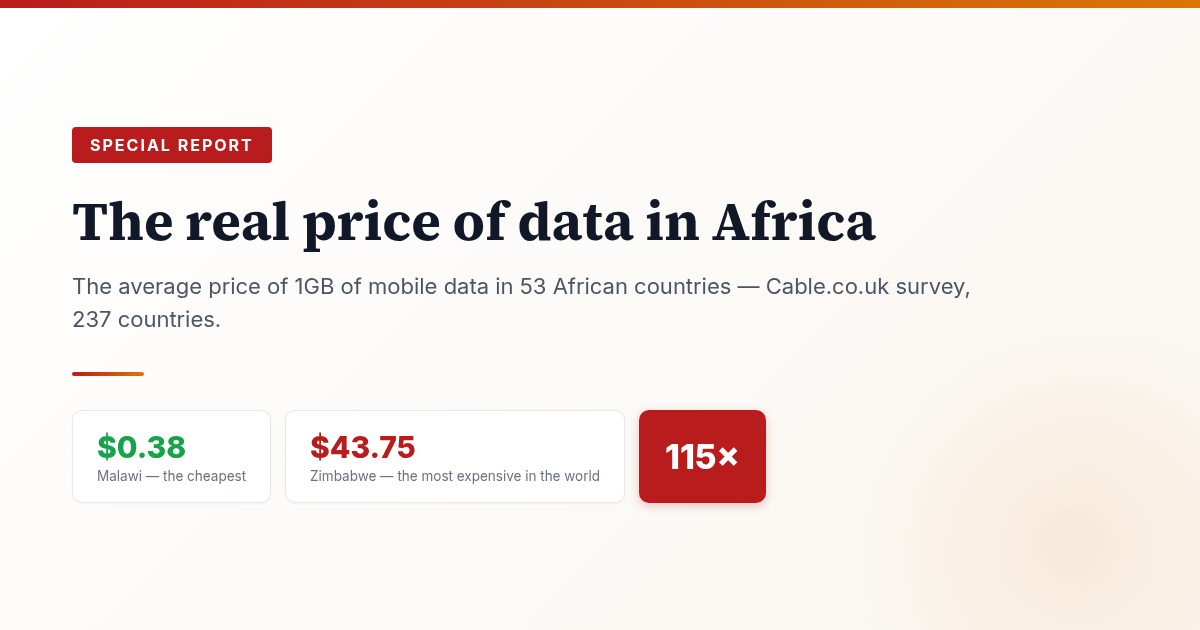
One gigabyte of mobile data costs $0.38 in Malawi and $43.75 in Zimbabwe — a 115-fold gap between two African countries for an identical product. Meanwhile, North Africa posts the cheapest mobile data on the planet, averaging just $0.86 per GB. Here is the full ranking of 53 African countries, with every figure sourced and explained.
Where the numbers come from
The data behind this ranking comes from the annual Cable.co.uk Worldwide Mobile Data Pricing survey — the most widely cited global benchmark on the subject. It measures the average cost of 1 GB of mobile data by aggregating more than 5,600 plans across 237 countries and territories, with all prices converted to US dollars at the time of the survey. Prepaid, postpaid and data-only plans are included; roaming, eSIM and travel packages are excluded. 53 of Africa’s 54 countries appear in the study — Eritrea is absent due to insufficient comparable data.
A necessary caveat. This ranking measures an average price per gigabyte, not the real cost of connectivity for households. Purchasing power, network coverage (2G/3G/4G/5G) and average income all shape whether a given price is genuinely affordable. One dollar per GB weighs far more heavily on a household in Bangui than one in Rabat. Prices also shift constantly and vary across operators within the same market.
The full ranking: mobile data price per GB across 53 African countries
Download the full ranking in PDF
All 53 countries, the methodology and the detailed analysis — to keep and share.
| Rank | Country | Price per GB (USD) |
|---|---|---|
| 1 | Malawi | $0.38 |
| 2 | Nigeria | $0.39 |
| 3 | Ghana | $0.40 |
| 4 | Somalia | $0.50 |
| 5 | DR Congo | $0.52 |
| 6 | Rwanda | $0.55 |
| 7 | Kenya | $0.59 |
| 8 | Morocco | $0.63 |
| 9 | Egypt | $0.65 |
| 10 | Mauritius | $0.67 |
| 11 | Sierra Leone | $0.67 |
| 12 | Republic of Congo | $0.68 |
| 13 | Ethiopia | $0.68 |
| 14 | Algeria | $0.73 |
| 15 | Mozambique | $0.78 |
| 16 | Libya | $0.82 |
| 17 | Tanzania | $0.84 |
| 18 | Angola | $1.01 |
| 19 | Burundi | $1.10 |
| 20 | Uganda | $1.11 |
| 21 | Madagascar | $1.12 |
| 22 | Sudan | $1.16 |
| 23 | Côte d’Ivoire | $1.18 |
| 24 | Namibia | $1.20 |
| 25 | Eswatini | $1.26 |
| 26 | Djibouti | $1.26 |
| 27 | Tunisia | $1.28 |
| 28 | Mauritania | $1.32 |
| 29 | Togo | $1.45 |
| 30 | Guinea | $1.51 |
| 31 | Equatorial Guinea | $1.59 |
| 32 | Cameroon | $1.63 |
| 33 | Senegal | $1.63 |
| 34 | Niger | $1.63 |
| 35 | South Africa | $1.81 |
| 36 | Lesotho | $1.96 |
| 37 | Botswana | $1.99 |
| 38 | Comoros | $2.18 |
| 39 | Benin | $2.37 |
| 40 | São Tomé and Príncipe | $2.41 |
| 41 | Liberia | $2.50 |
| 42 | Guinea-Bissau | $2.72 |
| 43 | Cape Verde | $3.24 |
| 44 | Burkina Faso | $3.27 |
| 45 | Gambia | $3.56 |
| 46 | Gabon | $4.09 |
| 47 | Chad | $4.09 |
| 48 | Mali | $4.56 |
| 49 | Seychelles | $5.43 |
| 50 | Zambia | $8.01 |
| 51 | Central African Republic | $10.90 |
| 52 | South Sudan | $23.70 |
| 53 | Zimbabwe | $43.75 |
Source: Cable.co.uk, Worldwide Mobile Data Pricing (5,600+ plans, 237 countries). Average prices in US dollars.
A quick note on reading this table: the price shown is an average across all plans in each country. Cameroon, Senegal and Niger all post $1.63 per GB, yet their network coverage and service quality differ substantially. This is a market pricing indicator, not a measure of meaningful access.
The extremes: what drivesThe extremes: what drives $0.38 in Malawi and $43.75 in Zimbabwe
.38 in Malawi and .75 in Zimbabwe
Malawi ($0.38), Nigeria ($0.39) and Ghana ($0.40) each offer a gigabyte for under $0.40 — placing all three in the global top 40 and well below the worldwide average of approximately $2.60 per GB, according to Cable.co.uk. These are markets where operator competition is intense and regulatory frameworks have pushed prices down.
At the other end, three African countries rank among the ten most expensive mobile data markets on earth, according to the same survey:
- Zimbabwe — $43.75/GB: ranked #1 most expensive globally out of 237 territories. Hyperinflation has dollarised operator costs, while the formal postpaid plan market is tiny. The survey notes that most Zimbabweans buy small daily bundles for around $1 — a purchasing pattern that, when recalculated per gigabyte, inflates the average price dramatically.
- South Sudan — $23.70/GB: ranked #4 globally. Limited network infrastructure and extreme financing costs in a country still rebuilding after prolonged conflict.
- Central African Republic — $10.90/GB: ranked #8 globally. Post-conflict fragmentation and near-absent market competition produce a similar outcome.
Zambia ($8.01/GB) also features in the global top 15 most expensive markets, according to the source. For context, the British Overseas Territory of Saint Helena ($40.13/GB) — a remote island in the South Atlantic — ranks third globally, illustrating that extreme remoteness, not poverty alone, can drive prices to similar heights.
Four things this data actually tells us
1. Expensive data is not simply a poverty story. The common thread among the priciest markets is not low income per se — it is the absence of competition: very small user bases, operator monopolies or duopolies, satellite-dependent backhaul and post-conflict infrastructure collapse. Conversely, highly competitive low-income markets such as Malawi, Rwanda and DR Congo post some of the lowest prices on the continent.
2. North Africa is the cheapest mobile data region in the world. Averaging $0.86/GB across seven countries, according to Cable.co.uk, North Africa undercuts Asia and Eastern Europe. Morocco ($0.63), Egypt ($0.65) and Algeria ($0.73) anchor the region at the affordable end of the global spectrum.
3. Sub-Saharan Africa is both expensive and deeply uneven. The regional average sits at $3.31/GB — tenth out of thirteen global regions in the Cable.co.uk survey — but that figure is skewed sharply upward by Zimbabwe and South Sudan. Strip those two outliers out, and the majority of sub-Saharan countries fall below $2.00/GB.
4. Data pricing shapes the mobile money and fintech landscape. According to the source, in countries where data is most competitive — Nigeria, Ghana, Kenya, Rwanda — mobile money adoption and digital services have scaled fastest. The per-GB price has become a de facto development lever, and investors tracking Africa’s fintech and e-commerce sectors would do well to watch it.
Regional benchmarks in context
| Region | Countries surveyed | Avg. price per GB |
|---|---|---|
| North Africa | 7 | $0.86 |
| Sub-Saharan Africa | 50 | $3.31 |
| Asia (excl. Middle East) | 28 | $1.10 |
| Western Europe | 29 | $2.08 |
| North America | 4 | $4.59 |
Source: Cable.co.uk. The global average is approximately $2.60/GB — down from $8.18/GB in 2019, according to the same survey series.
Frequently asked questions
Why is Zimbabwe’s mobile data the most expensive in the world?
According to Cable.co.uk’s survey, hyperinflation has pushed operators to price entirely in US dollars, while the formal plan market remains extremely small. Most users purchase daily micro-bundles for around $1; when the cost of those bundles is expressed per gigabyte, the average price soars to $43.75 — the highest recorded globally across 237 territories.
Which African country has the cheapest mobile data?
Malawi, at $0.38/GB on average, leads the continent, followed by Nigeria ($0.39/GB) and Ghana ($0.40/GB), according to the Cable.co.uk data.
Are these prices in local currency or US dollars?
All figures in this ranking are in US dollars, as published by Cable.co.uk, which converts local prices at the prevailing exchange rate at the time of the survey.
How quickly do these figures change?
Rapidly. The global average price per gigabyte fell from $8.18 in 2019 to approximately $2.60 at the time of the latest edition — more than a threefold drop in roughly six years, according to Cable.co.uk. Country-level prices can shift significantly between survey editions as operators adjust plans and currencies fluctuate.
Source: Cable.co.uk — Worldwide Mobile Data Pricing (average price per GB, 5,600+ plans, 237 countries and territories). Last updated: 2 October 2026. This article is for information purposes only and does not constitute investment or commercial advice. Corrections: [email protected]

Moussa D.
Editor-in-chief of lesafriques.com. An economic journalist trained in Tunis, he sets the editorial line and reviews every article before publication. He ensures every figure is sourced, verified and dated, in line with the site's methodology.
View all articles → · LinkedIn ↗


